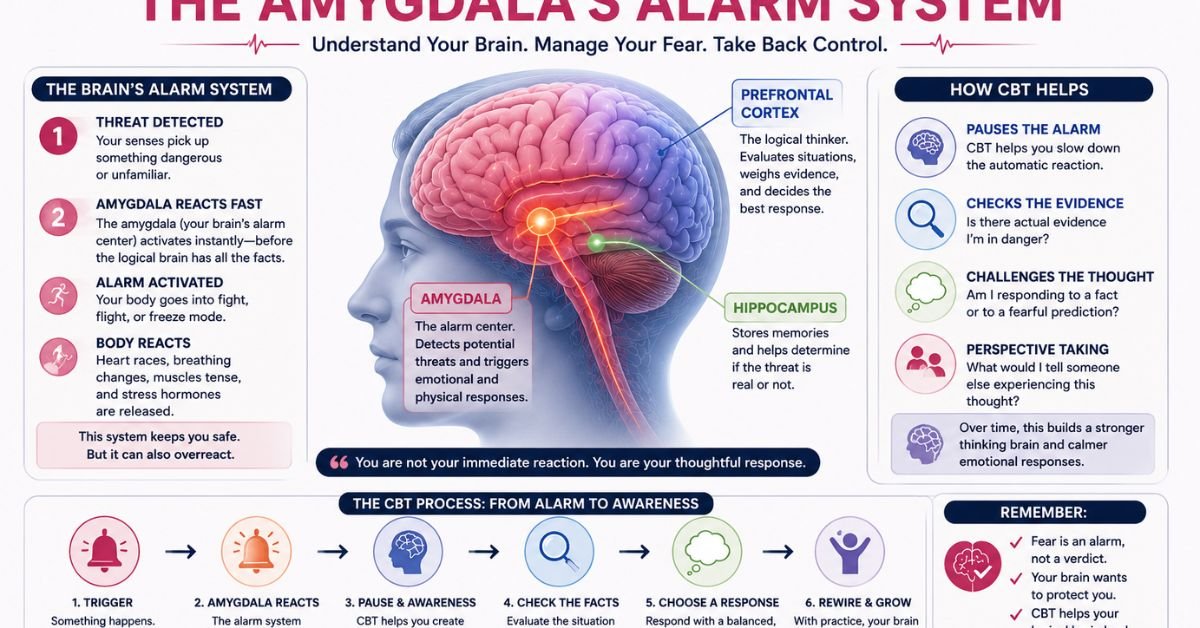



Introduction: When Fear Becomes Bigger Than the M
Others appear even when life looks normal.Why Fear of death
Working.
Scrolling.
Trying to sleep.
Then suddenly a thought appears:CBT Explains the Amygdala’s Alarm System
“What if something happens?”
Your heart becomes noticeable.
Your attention turns inward.CBT & Amygdala Explained
And within seconds your brain begins collecting evidence. CBT Explains the Amygdala’s Alarm System
This feeling can become especially intense when the fear centers around death.CBT Explains the Amygdala’s Alarm System
People often describe it this way:
- I know I am okay.
- But I do not feel okay.
- I cannot stop thinking about what if.
This experience can feel confusing.
Because logic and fear seem disconnected.thats why CBT & Amygdala Explained fear of death
That is where CBT offers another way of understanding.
Sometimes fear is not proof of danger.
Sometimes fear is the nervous system trying very hard to keep you alive.CBT Explains the Amygdala’s Alarm System
One important part of that system is the amygdala.CBT & Amygdala Explained
What Is the Amygdala and Why Does It Matter?
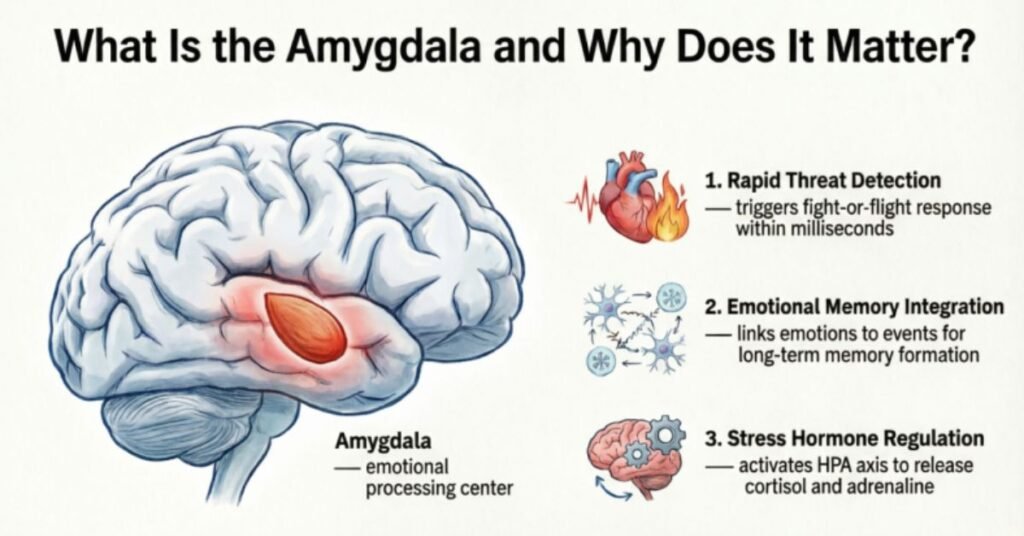
The amygdala is a small structure in the brain involved in detecting possible threats.
Its job is not happiness.That is where CBT offers another way of understanding.Sometimes fear is not proof of danger. CBT Explains the Amygdala’s Alarm System
Its job is protection.
When it notices something that feels uncertain, unfamiliar, or dangerous, it can trigger survival responses before the thinking brain fully evaluates the situation.
That reaction can create:
- Faster heartbeat
- Muscle tension
- Increased alertness
- Rapid thoughts
- Urgency to find certainty
This process helps survival.CBT & Amygdala Explained
But sometimes the alarm becomes too sensitive.
Your Brain’s Built-In Alarm System
Think of the amygdala as your brain’s smoke alarm.CBT & Amygdala Explained
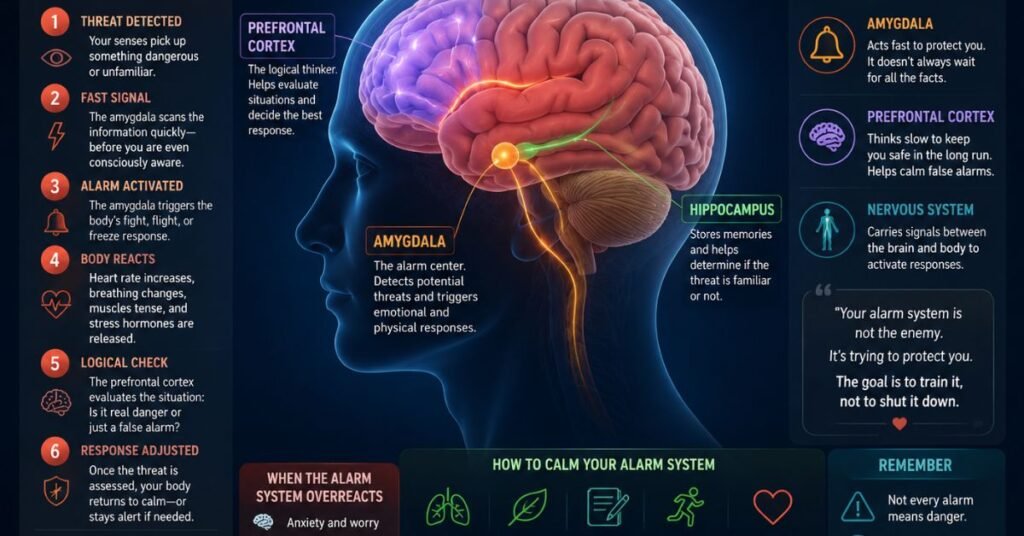
Its job is simple:CBT &; Amygdala Explained
- Detect potential danger.
- Trigger a rapid survival response.
- Prepare your body to protect itself.
When you face a genuine threat—such as a speeding car or an aggressive animal—this rapid response can save your life. The amygdala signals your nervous system to release stress hormones like adrenaline and cortisol, increasing your heart rate, speeding up breathing, and sharpening attention.Sometimes fear is not proof of danger. CBT Explains the Amygdala’s Alarm System
When the Alarm Goes Off Without Real Danger | CBT & Amygdala Explained
The amygdala does not always distinguish between actual danger and perceived danger.
Sometimes a simple thought can activate the same alarm:CBT & Amygdala Explained
“What if I suddenly die?”
“What if I have a heart attack?”
“What if something terrible happens?”
Even though you’re safe at home, your brain reacts as if the threat is real.CBT & Amygdala Explained
That’s why you may notice:CBT & Amygdala Explained
- A racing heart
- Chest tightness
- Fast breathing
- Dizziness
- Sweaty palms
- Feeling detached from reality
- Constant body checking
The body isn’t necessarily signaling danger—it may simply be responding to an anxious prediction.| CBT & Amygdala Explained
Why This Matters in CBT
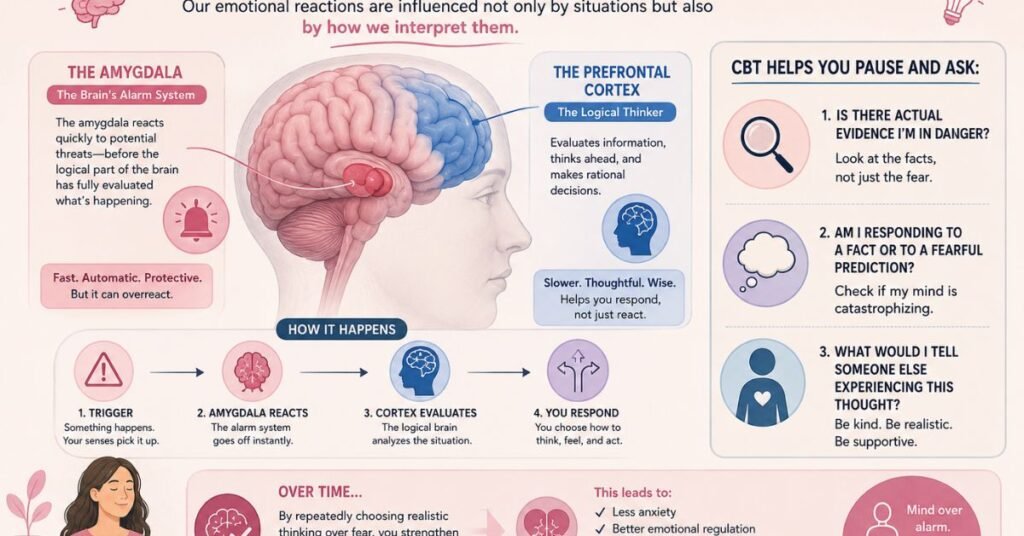
Cognitive Behavioral Therapy (CBT) teaches that our emotional reactions are influenced not only by situations but also by how we interpret them.CBT &; Amygdala Explained
The amygdala reacts quickly, before the logical part of the brain—the prefrontal cortex—has fully evaluated what’s happening.
CBT helps strengthen that thinking system so you can ask:CBT & Amygdala Explained
- Is there actual evidence I’m in danger?
- Am I responding to a fact or to a fearful prediction?
- What would I tell someone else experiencing this thought?why Fear of Death Feels So Real
Over time, repeatedly responding with realistic thinking instead of fear can reduce unnecessary alarm responses and improve emotional regulation.
Fear Isn’t Always a Sign of Danger CBT Explains the Amygdala’s Alarm System
One of the most reassuring facts from neuroscience is this:
The amygdala’s job is to keep you alive not to make you feel calm..CBT & Amygdala Explained
Sometimes it becomes overly sensitive after prolonged stress, trauma, panic attacks, or chronic anxiety. In those cases, it may interpret harmless situations as dangerous.
That doesn’t mean you’re losing control.
It means your brain is trying sometimes too aggressively to protect you.CBT & Amygdala Explained
Key Takeaway Why Fear of Death Feels So Real: CBT Explains the Amygdala’s Alarm System
If you experience sudden fears while drinking tea, working, scrolling your phone, or trying to sleep, it doesn’t automatically mean something is wrong with your body.
Sometimes it’s your amygdala reacting to a “what if” thought rather than to a real threat.Fear Isn’t Always a Sign of Danger CBT Explains the Amygdala’s Alarm System
The encouraging news is that, through CBT, mindfulness, gradual exposure, and healthy stress-management habits, the brain can learn that these thoughts are not emergencies, allowing the alarm system to become less reactive over time
Internal Link Opportunities (Healora CBT)
Link naturally to related articles on your website such as:
- CBT for Anxiety: How Thoughts Affect Feelings and Behaviors
- What Is the Fight-or-Flight Response?
- How CBT Helps Stop Catastrophic Thinking
- The CBT Thought Record: Challenge Anxious Thoughts
- How Mindfulness Calms an Overactive Mind
- Understanding Panic Attacks: Symptoms, Causes & CBT Treatment
- Emotional Safety and Trust in Relationships
- Overthinking vs Problem Solving: CBT Guide
- CBT Breathing Exercises for Anxiety
Example within the text:CBT & Amygdala ExplainedWhy Fear of Death Feels So Real: CBT Explains the Amygdala’s Alarm System
The amygdala reacts quickly to perceived danger. Learning CBT techniques can help retrain these automatic responses. (Internal link: CBT for Anxiety)
Authoritative References (APA 7th Edition)
- AbuHasan, Q., Reddy, V., & Siddiqui, W. (2024). Neuroanatomy, Amygdala. StatPearls Publishing. National Library of Medicine.
- Cleveland Clinic. (2023). Amygdala: What It Is and What It Controls.
- Cleveland Clinic. (2025). Prefrontal Cortex: What It Is, Function, Location & Damage.
- Pessoa, L. (2010). Emotion, Cognition, and Mental State Representation in Amygdala and Prefrontal Cortex. Annual Review of Neuroscience, 33, 173–202.
- Purves, D., Augustine, G. J., Fitzpatrick, D., et al. (2001). Neuroscience (2nd ed.). Sunderland, MA: Sinauer Associates. Chapter: The Relationship Between Neocortex and Amygdala.
- Cleveland Clinic. (2022). Cognitive Behavioral Therapy (CBT): What It Is & Techniques.
- LeDoux, J. E. (2000). Emotion circuits in the brain. Annual Review of Neuroscience, 23, 155–184.
- Ressler, K. J., & Mayberg, H. S. (2007). Targeting abnormal neural circuits in mood and anxiety disorders. Nature Neuroscience, 10(9), 1116–1124.
- American Psychiatric Association. (2022). Diagnostic and Statistical Manual of Mental Disorders (5th ed., text rev.).
- Beck, J. S. (2021). Cognitive Behavior Therapy: Basics and Beyond (3rd ed.). Guilford Press.
Key Evidence You Can CitCAT Explains the Amygdala’s Alarm System
- The amygdala rapidly detects potential threats and initiates the body’s fight-or-flight response.
- The prefrontal cortex supports reasoning, self-control, and emotion regulation, helping evaluate whether a perceived threat is real.
- CBT is an evidence-based psychotherapy that helps people identify and modify unhelpful thought patterns and behaviors associated with anxiety.
These references are appropriate for an evidence-based article aimed at explaining why fear can feel intense even in the absence of immediate danger.@Web search who or authentic wikipedia links referencehttps://en.wikipedia.org/wiki/Cognitive_behavioral_ther CBT & Amygdala Explained
Story: The Day Fear Became a Habit CBT &; Amygdala Explained
One evening, someone notices their heartbeat.psychoanalyst Aaron Beck
Nothing unusual.
But they pay attention.
Then they check again.
Then search online.
Then ask others.
Temporary relief comes.
But the next day the question returns.CBT &; Amygdala Explained
Eventually life becomes smaller.
Not because danger increased.
Because attention increased.
Fear slowly became a routine.
This is how survival loops begin.
Why Fear of Death Feels So Convincing

Fear becomes convincing because the body participates.
When the nervous system activates:
- the body changes
- the mind searches
- thoughts become urgent
The brain often assumes:
Strong feeling = important.
Important = dangerous.
But intensity is not always accuracy.CBT Explains the Amygdala’s Alarm System
Table: Survival Mode vs Present-Moment Safety
| Survival Mode | Present-Moment Awareness |
| Constant checking | Observation |
| What if thinking | Evidence-based thinking |
| Urgency | Response |
| Hyper-alertness | Flexible attention |
| Avoidance | Gradual engagement |
Common Causes That Keep the Brain Alert
1. Long-Term Stress
Stress teaches the brain to scan.
The longer scanning continues, the easier activation becomes.
2. Body Monitoring
The more attention moves inward, the louder normal sensations feel.
3. Avoidance
Avoiding fear often strengthens fear.
4. Searching for Absolute Certainty
The nervous system wants guarantees.
Life rarely gives them.
How CBT Explains Fear of Death
CBT does not ask:
“Why do I feel this?”
Only.CBT Explains the Amygdala’s Alarm System
It also asks:
“What meaning am I giving this feeling?”
Examples:
Situation:
Heartbeat noticed
Automatic thought:
Something is wrong
Emotion:
Fear
Behavior:
Checking
Short-term result:
Relief
Long-term result:
Fear returns stronger
This is where change begins.CBT Explains the Amygdala’s Alarm System
Internal Linking Opportunities for HealoraCBT
Add links naturally to:CBT Explains the Amygdala’s Alarm System
- Why You Wake Up Tired — CBT & Brain Science
- From Old Beliefs to New Possibilities
- Why the Mind Stays on Alert
- Identity Healing: You Are Not Your Survival Response
Small Daily CBT Practices

Try noticing-cbt-amygdala-explained/
- What happened?
- What did I think?
- What did my body do?
- What evidence supports this thought?
- What else could explain it?
The goal is not perfectly calm.CBT Explains the Amygdala’s Alarm System
The goal is more flexibility.
FAQs
Is fear of death normal?
Fear about mortality exists across human experience. It becomes more disruptive when it starts controlling daily life.
Can the amygdala create physical symptoms?
Fear responses can influence physical sensations such as tension, alertness, and heartbeat awareness.
Does CBT remove fear?
CBT usually focuses on changing relationships with thoughts and responses rather than eliminating emotions.
Why does fear feel real even when I know I am safe?
Because emotional alarm systems can activate faster than reflective thinking.
Conclusion
Fear of death often feels personal.CBT Explains the Amygdala’s Alarm System
But sometimes it is biological.
The brain wants to protect life.
The nervous system wants certainty.
The amygdala wants preparation.
CBT offers something different.
Not endless reassurance.
Not forcing positivity.
But learning that feeling fear and being unsafe are not always the same thing.CBT Explains the Amygdala’s Alarm System
Healing often begins when the brain no longer has to treat every uncertain moment as an emergency.