

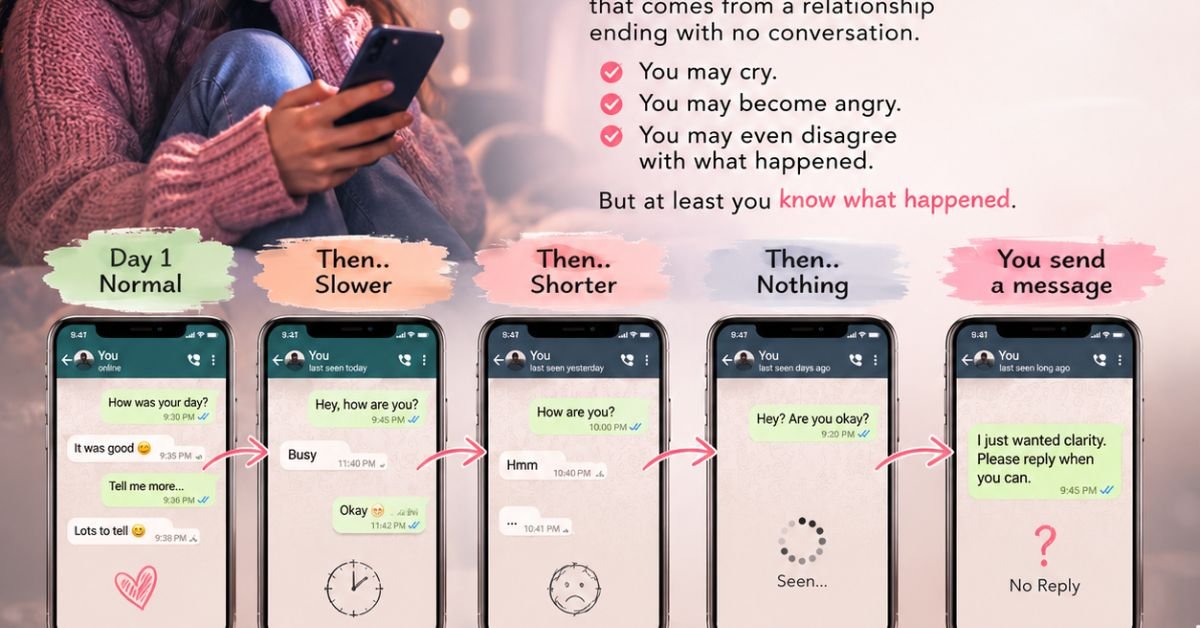
Technology has changed.
The human need for connection, explanation and emotional safety has not.
- Romantic relationships
- Situationships
- Friendships
- Dating-app connections
- Long-distance relationships
- Professional relationships
- Social media interactions
Ghosting can range from disappearing after a few conversations to withdrawing from a long-term relationship.
The emotional impact often depends on how much meaning, attachment and expectation existed before the silence.
A person you exchanged three messages with may be disappointing.
A person who discusses marriage, family or a future with you may leave a much deeper emotional wound.
Why Does Ghosting Hurt So Much?
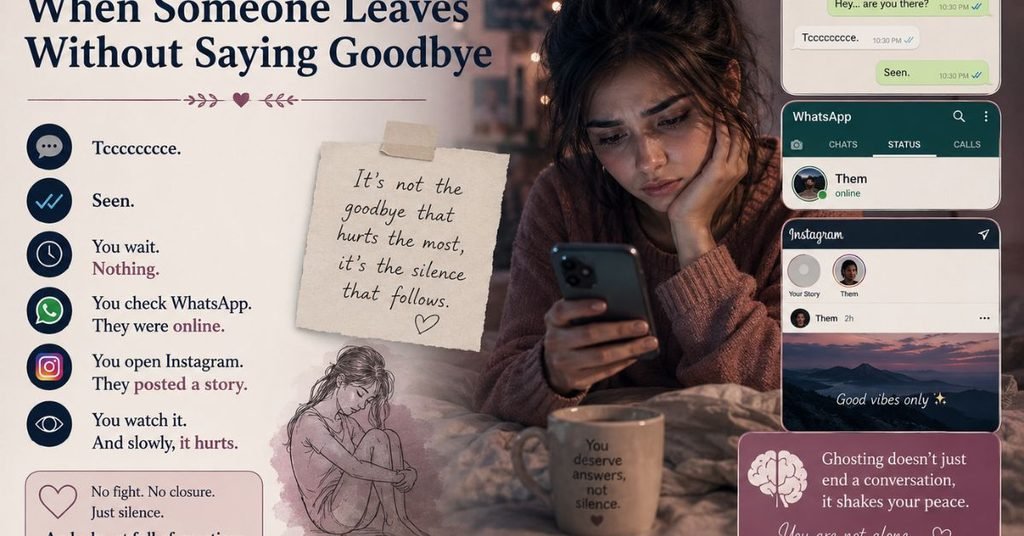
The obvious answer is rejection.
But there is another important factor:
Uncertainty.
When someone clearly says:
“I don’t want to continue this relationship.”
you may not like the answer, but your brain receives information.
Ghosting removes that information.
What Is Ghosting?
And searching can become rumination.
You replay conversations.
You analyze the last message.
You look for clues.
You revisit old photographs.
You check social media.
You ask friends what they think.
You create possible explanations.
This can turn a relationship that has physically ended into a relationship that remains psychologically active
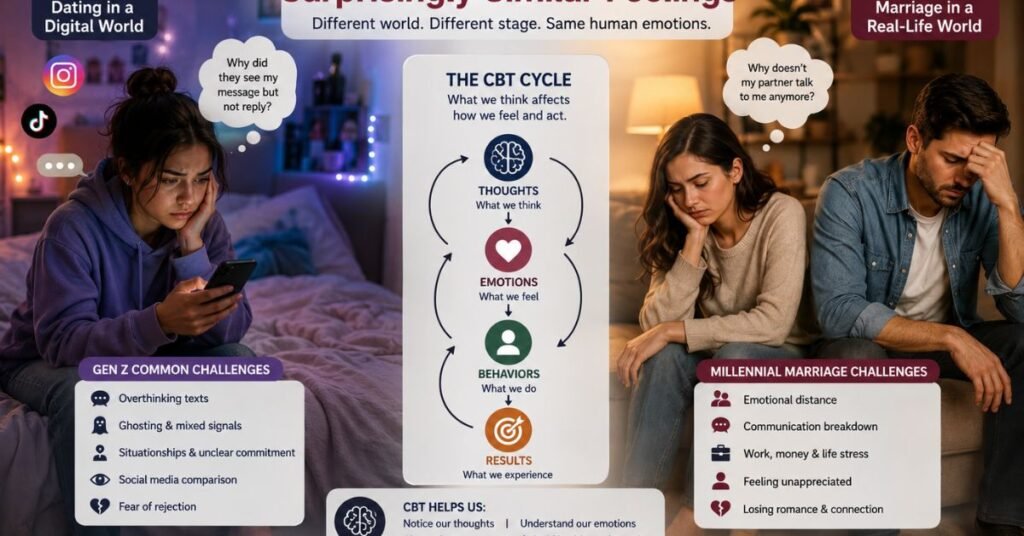
Gen Z vs Millennials: Why Ghosting Feels Different
Gen Z: The Generation of Digital Visibility
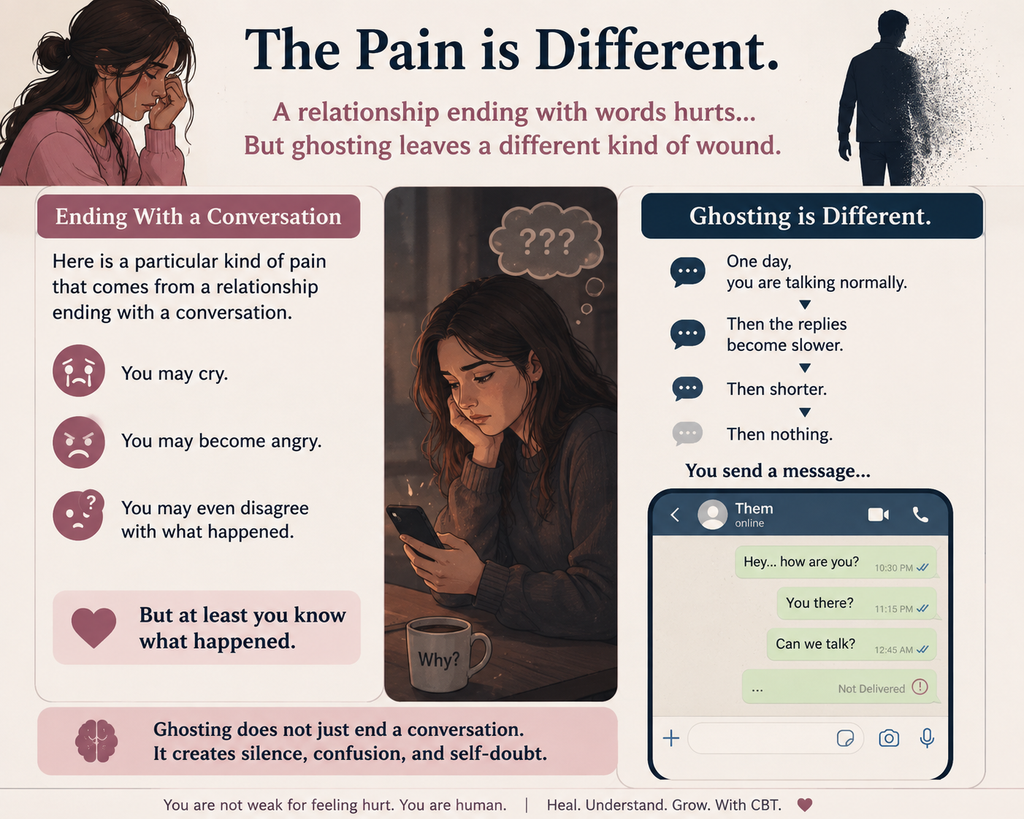
Gen Z relationships exist in an environment of constant digital visibility.
Someone can disappear from your chat while remaining visible everywhere else.
They can:
- View your Instagram story
- Like someone’s post
- Upload a TikTok
- Change their profile picture
- Follow new people
- Appear online
- Read your message
This creates a strange contradiction:
They are absent from the relationship but present in the digital environment.
That can make emotional detachment more difficult.
Imagine this:
You haven’t spoken for two weeks.
You are finally beginning to accept it.
Then you see:
“View your story.”
Your brain immediately asks:
“Why?”
One tiny digital signal can reopen an entire emotional story.
But a story view is not a conversation.
An online status is not an explanation.
A like is not commitment.
And digital visibility should not automatically be interpreted as emotional intention.
Millennials: When Emotional History Makes Silence Hurt
Millennials experienced relationships during a major technological transition.
Many remember a time when communication involved:
- Landline calls
- SMS
- Emails
- Waiting for someone to call
- Meeting without constant online updates
Then came Facebook, smartphones, WhatsApp, Instagram and dating apps.
For many Millennials, ghosting may feel especially painful when there has been significant emotional investment.
The thought may be:
“After everything we shared, why couldn’t you simply communicate with me?”
It isn’t necessarily the absence of the relationship that hurts.
It can be the absence of respectful communication at the end of the relationship.
The Generation Difference Isn’t as Big as We Think
Gen Z and Millennials may use different platforms and communication styles.
But beneath the technology, the psychological experience can be remarkably similar.
Both may experience:
Rejection
Uncertainty
Overthinking
Attachment activation
Loss of control
Self-doubt
Desire for closure
The difference may be the environment in which these emotions are experienced.
Gen Z may have more digital reminders.
Millennials may have more emphasis on the emotional history of the relationship.
But both can become trapped in an unfinished story.
The Psychology of an Unfinished Story
Why does your brain keep returning to someone who isn’t communicating?
Because your brain is designed to detect patterns and resolve uncertainty.
When information is incomplete, the mind often tries to complete it.
This can create a psychological loop:
Trigger
“They haven’t replied.”
↓
Automatic Thought
“Maybe they don’t want me anymore.”
↓
Emotion
Anxiety, sadness or anger.
↓
Behavior
Check WhatsApp.
↓
Temporary Relief
“They were online.”
↓
New Question
“Why didn’t they reply?”
↓
More Checking
And the loop begins again.
This is exactly where CBT for ghosting can become useful.
CBT for Ghosting: Separate Facts From Stories
Cognitive Behavioral Therapy focuses on the relationship between:
Thoughts → Emotions → Behaviors
After ghosting, the mind can quickly turn assumptions into facts.
For example:
Fact:
“They haven’t replied.”
Thought:
“They hate me.”
Fact:
“They viewed my story.”
Thought:
“They secretly want me back.”
Fact:
“They became distant.”
Thought:
“I must have done something wrong.”
CBT encourages a different question:
“What evidence do I actually have?”
This doesn’t make the pain disappear.
It makes the thinking more balanced.
The Ghosting Thought Record
Try this simple CBT exercise.
Situation
What happened?
“They stopped responding.”
Automatic Thought
What did your mind immediately say?
“I wasn’t important enough.”
Emotion
What did you feel?
Sadness: 80%
Anxiety: 75%
Anger: 40%
Evidence For the Thought
Maybe communication changed.
Evidence Against the Thought
Their communication behavior doesn’t determine your personal worth.
Balanced Thought
“I don’t know exactly why they stopped communicating. I know their behavior hurts me, but I don’t need to turn their decision into a judgment about my value.”
That is a CBT-based shift.
Ghosting and Anxious Attachment
Ghosting can be particularly difficult when someone already has a tendency toward anxious attachment.
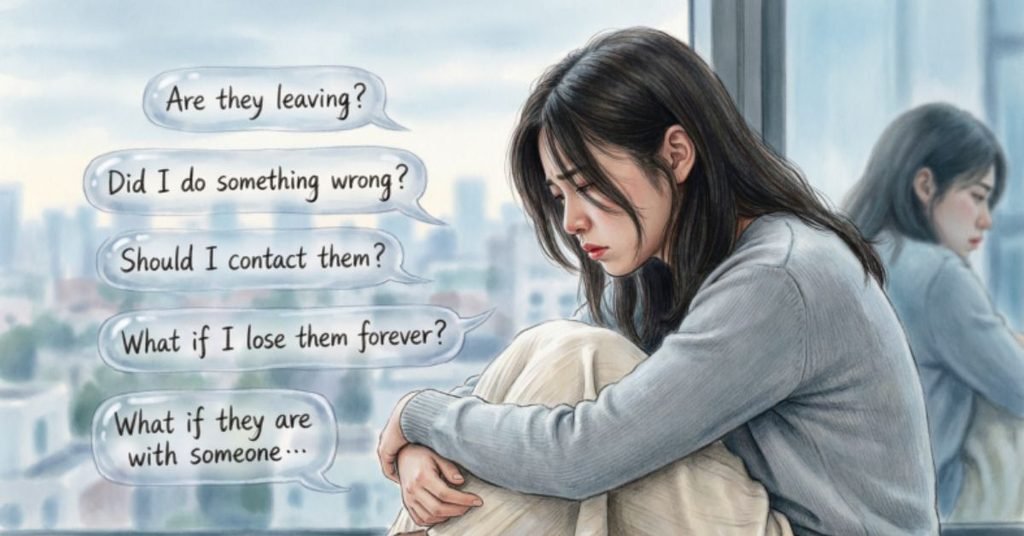
The silence can activate questions such as:
The nervous system wants certainty.
- “Are they leaving?”
- “Did I do something wrong?”
- “Should I contact them?”
- “What if I lose them forever?”
- “What if they are with someone else?”
So the person may seek reassurance through:
Texting
Calling
Checking profiles
Asking friends
Reading old conversations
Looking for signs
But reassurance can become temporary.
You feel better for five minutes.
Then another question appears.
This is why emotional healing requires more than simply telling yourself:
“Don’t think about them.”
You need a different response to the thought.
Don’t Confuse a Thought With a Fact
One of the most important CBT principles for emotional healing is:
A thought is not automatically a fact.
“I wasn’t enough” is a thought.
“They will come back” is a thought.
“They secretly miss me” is a thought.
“They never cared” is also a thought.
You don’t have to fight every thought.
You can observe it.
Then ask:
Is this fact, interpretation or prediction?
That simple distinction can reduce emotional intensity.
NLP Perspective: Changing the Meaning of the Story
NLP-based self-help can offer another way of looking at the experience.
Imagine two people experience the same event:
Someone ghosts them.
Person A thinks:
“I was rejected because something is wrong with me.”
Person B thinks:
“This experience showed me that I need clearer communication and stronger boundaries.”
The event is similar.
The meaning is different.
The emotional consequences may therefore be different.
A useful self-reflection question is:
“What meaning have I attached to this experience?”
Maybe you have unconsciously turned:
“They left.”
into:
“Nobody stays.”
Or:
“They chose someone else.”
into:
“I am replaceable.”
Or:
“They didn’t explain.”
into:
“I am not worthy of an explanation.”
These are much bigger conclusions than the original event.
What Ghosting Does Not Prove
Being ghosted does not automatically prove that:
- You were unlovable.
- You were boring.
- You were replaceable.
- The entire relationship was fake.
- You will always be abandoned.
- Nobody will communicate honestly with you again.
Ghosting tells you something about the other person’s behavior and the relationship dynamic.
It does not give them authority to define your identity.
Why Checking Their Social Media Keeps You Stuck
Imagine a wound that is beginning to heal.
Every time you check their profile, you mentally reopen it.
You see a photograph.
You interpret a caption.
You notice a new follower.
You wonder who they are talking to.
You imagine their life without you.
Your brain receives another emotional stimulus.
This is why a digital boundary can become an important part of healing.
You may need to:
- Mute their stories
- Archive the conversation
- Stop checking their last seen
- Remove unnecessary notifications
- Take a temporary social-media break
This isn’t childish.
It can be emotional hygiene.
Do You Need to Send One More Message?
This is one of the most common questions after ghosting.
There is no universal answer.
But ask yourself:
“Am I communicating something important, or am I trying to reduce my anxiety?”
If you’re sending another message because you genuinely need to communicate a practical matter, that’s different.
If you’re sending five paragraphs because you’re hoping their reply will finally make you feel safe, you may be reinforcing the cycle.
Sometimes the most powerful message is the one you don’t send.
Closure Doesn’t Always Come From the Other Person
We often imagine closure as a conversation.
They explain.
We understand.
We forgive.
We move on.
Real life doesn’t always work that way.
Sometimes the person who created the uncertainty doesn’t provide the explanation needed to resolve it.
So healing may require creating an internal conclusion:
“I don’t know why they did it. But I know the relationship became inconsistent, and I know I deserve communication that is clear and respectful.”
That can be enough to move forward.
The Difference Between Missing Someone and Needing Them
This is an important distinction.
You can miss someone.
And still choose not to contact them.
You can remember beautiful moments.
And still accept that the relationship wasn’t healthy for you.
You can wonder about them.
And still continue your life.
Emotional healing isn’t:
“I’ll never think about them again.”
It is:
“Thinking about them no longer controls what I do.
The Unfinished Future
Sometimes you’re not grieving the person.
You’re grieving the future you imagined.
Maybe you imagined:
- Marriage
- Children
- Travel
- A home
- Emotional security
- Growing old together
When the relationship disappears, that imagined future disappears too.
This is why saying:
“Just forget them.”
can be unhelpful.
You’re not deleting a contact.
You’re processing an expectation.
And expectations can require grief.
Day 2 Review: Fact vs. Assumption → CBT for Happy Married Life – Day 2
A 5-Step CBT Healing Process After Ghosting
Step 1: Name the Trigger
Don’t say:
“My whole life is falling apart.”
Say:
“I was triggered when I saw their story.”
Naming the trigger creates psychological distance.
Step 2: Identify the Automatic Thought
Ask:
“What did I tell myself?”
Step 3: Challenge the Interpretation
Ask:
“What do I know for certain?”
Step 4: Choose a New Behavior
Instead of checking their profile:
Take a walk.
Journal.
Call a supportive friend.
Practice breathing.
Return to your routine.
Step 5: Choose Direction Over Rumination
Ask:
“What action moves my life forward today?”
A 60-Second Self-Help Exercise
When the urge to check their profile appears:
Pause.
Take a slow breath.
Notice the thought.
Don’t fight it.
Say:
“This is an urge, not an instruction.”
Take another breath.
Ask:
“What would protect my peace right now?”
Then choose one small action.
Drink water.
Walk.
Stretch.
Journal.
Return to work.
Talk to someone supportive.
The objective isn’t to suppress your emotions.
It is to stop allowing every emotion to control your behavior.
Gen Z Can Learn From Millennials
Gen Z can benefit from remembering that:
Digital communication isn’t the same as emotional communication.
A person can watch your story and still be unable—or unwilling—to have a mature conversation.
Don’t build an entire relationship around digital clues.
Millennials Can Learn From Gen Z
Millennials can benefit from understanding that:
Digital boundaries are real boundaries.
Muting someone, limiting exposure or stepping away from social media can be legitimate tools for emotional regulation.
You don’t have to remain digitally connected to prove that you are emotionally mature.
What Both Generations Can Learn
Whether you’re Gen Z or a Millennial:
Don’t confuse:
Attention with commitment.
Chemistry with compatibility.
Story views with communication.
Potential with reality.
Silence with mystery.
And most importantly:
Don’t confuse someone’s inability to communicate with your lack of worth
When Ghosting Becomes a Pattern
One painful experience is difficult.
Repeated ghosting can become a relationship pattern.
You may notice:
Strong connection → Emotional intensity → Uncertainty → Withdrawal → Anxiety → Chasing → Disappointment
If this keeps happening, don’t only ask:
“Why do people keep leaving me?”
Also ask:
“What patterns am I repeatedly entering?”
Are you choosing emotionally unavailable people?
Are you ignoring early red flags?
Are you becoming attached before consistent behavior develops?
Are you accepting ambiguity because you hope it will eventually become commitment?
These questions aren’t about blaming yourself.
They’re about increasing awareness.
What Healthy Communication Looks Like
A healthy ending might sound like:
“I’ve enjoyed getting to know you, but I don’t think we’re compatible. I don’t want to continue romantically, and I wish you well.”
It may hurt.
But it creates clarity.
Ghosting creates ambiguity.
Healthy communication creates information.
And information gives the brain something it can process.
When Professional Support May Help
If ghosting triggers intense emotional distress, persistent rumination, sleep disruption, difficulty functioning or repeated relationship patterns, speaking with a qualified mental-health professional can be helpful.
CBT can be particularly useful for examining:
- Automatic thoughts
- Anxiety loops
- Rumination
- Cognitive distortions
- Attachment-related behaviors
- Boundary setting
- Emotional regulation
Self-help can support healing, but it doesn’t replace professional care when symptoms become severe or persistent.
How Healora CBT Frames Ghosting
At Healora CBT, the focus is not simply:
“How do I forget this person?”
The deeper question is:
“How do I understand what happened without allowing it to control my identity?”
The CBT framework becomes:
Trigger → Thought → Emotion → Behavior → Consequence
Then:
Awareness → Reframing → Healthier Response → New Direction
The goal isn’t to erase your memories.
It is to change the relationship you have with those memories.
Frequently Asked Questions
What is ghosting?
Ghosting is when someone suddenly stops communicating without providing a clear explanation or ending to the relationship.
Why does ghosting hurt more than a normal breakup?
Ghosting can be especially painful because it combines rejection with uncertainty. The lack of explanation may encourage repeated questioning and rumination.
Why does Gen Z experience ghosting differently?
Gen Z relationships are highly connected to social media and messaging platforms. The ghoster may remain digitally visible even after communication stops, creating additional emotional triggers.
Do Millennials experience ghosting differently?
Millennials may experience ghosting through a different communication history, particularly when significant emotional investment existed before digital communication suddenly stopped.
Can CBT help with ghosting?
Yes. CBT can help identify automatic thoughts, separate facts from interpretations, challenge cognitive distortions and develop healthier behavioral responses.
How do I stop checking their social media?
Create a temporary digital boundary. Mute or unfollow if necessary, remove notifications and replace checking behavior with a specific alternative activity.
Does a story view mean my ghoster still cares?
Not necessarily. A social-media interaction is not reliable evidence of someone’s emotional intentions.
How can I get closure after ghosting?
Closure may involve accepting what you know, acknowledging what you don’t know, setting boundaries and deciding that your future does not need to depend on another person’s explanation.
Final Thought: Your Story Can End Without Their Permission
Maybe you never get the explanation.
Maybe they never send the message you hoped for.
Maybe you’ll always wonder what really happened.
But eventually, you can reach a different question.
Not:
“Why didn’t they choose me?”
But:
“Why am I still allowing their choice to determine how I see myself?”
Gen Z and Millennials may experience ghosting through different technologies and relationship cultures.
But the healing principle is universal:
You don’t need to chase every unanswered question.
You can learn from the experience.
You can strengthen your boundaries.
You can challenge the thoughts that keep you stuck.
You can choose healthier relationships.
And you can walk away from an unfinished story without believing that your life is unfinished.


Pingback: From the Breaking Point to Inner Peace: Lisa’s 11-Day