

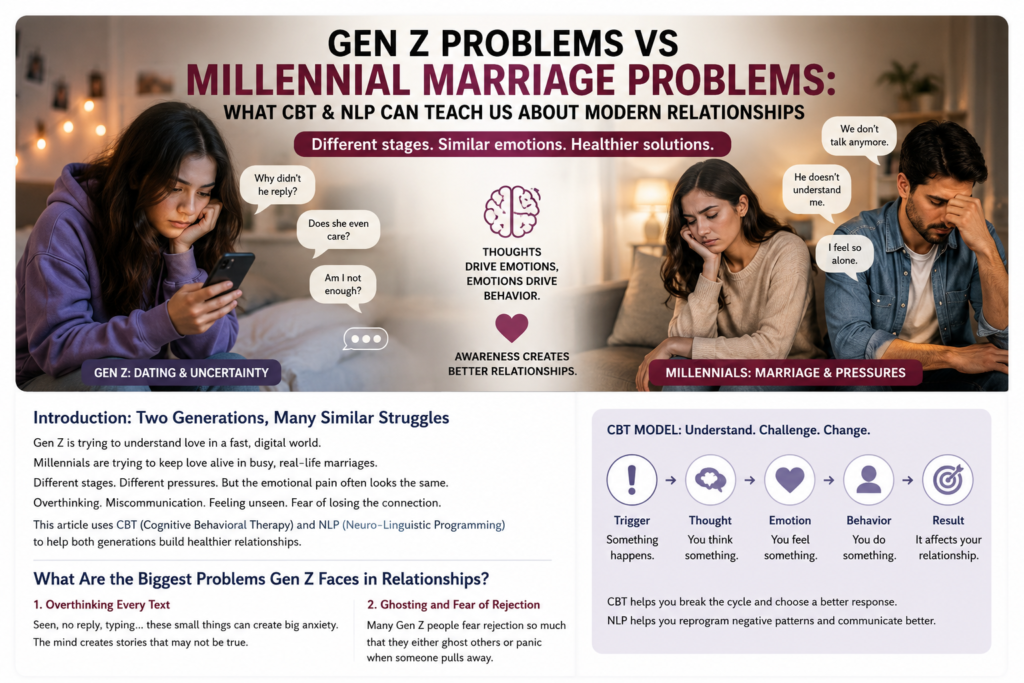
- CBT for relationship problems
- 2. Communication Problems
- 5. Parenting and Marriage
- What Do Gen Z and Millennials Have in Common?
- When Should You Use CBT Thinking in a Relationship?
- The CBT Relationship Thought Record
- How NLP Can Complement CBT in Relationship Work
- CBT + NLP: A Simple Relationship Reset
- What Can Gen Z Learn From Millennial Marriage?
- What Can Millennials Learn From Gen Z?
- What Does Healthy Dating Look Like?
- What Does Healthy Marriage Look Like?
- The Healora CBT Relationship Exercise
- The “If This Changes, I Will Not Lose Myself” Exercise
- How to Know When a Relationship Pattern Needs Attention
- What CBT Does Not Mean
- When Communication Is More Important Than Interpretation
- When Self-Work Becomes More Important Than Relationship Work
- A Modern Relationship Does Not Need to Be Perfect
- The Bigger Picture: Different Generations, Same Human Need
- The Healora Approach: Awareness Before Reaction
- Internal Linking Strategy for Healora CBT
- Suggested External Reference Sources
- Frequently Asked Questions
- Conclusion
CBT for relationship problems
Introduction: Different Generations, Surprisingly Similar Feelings
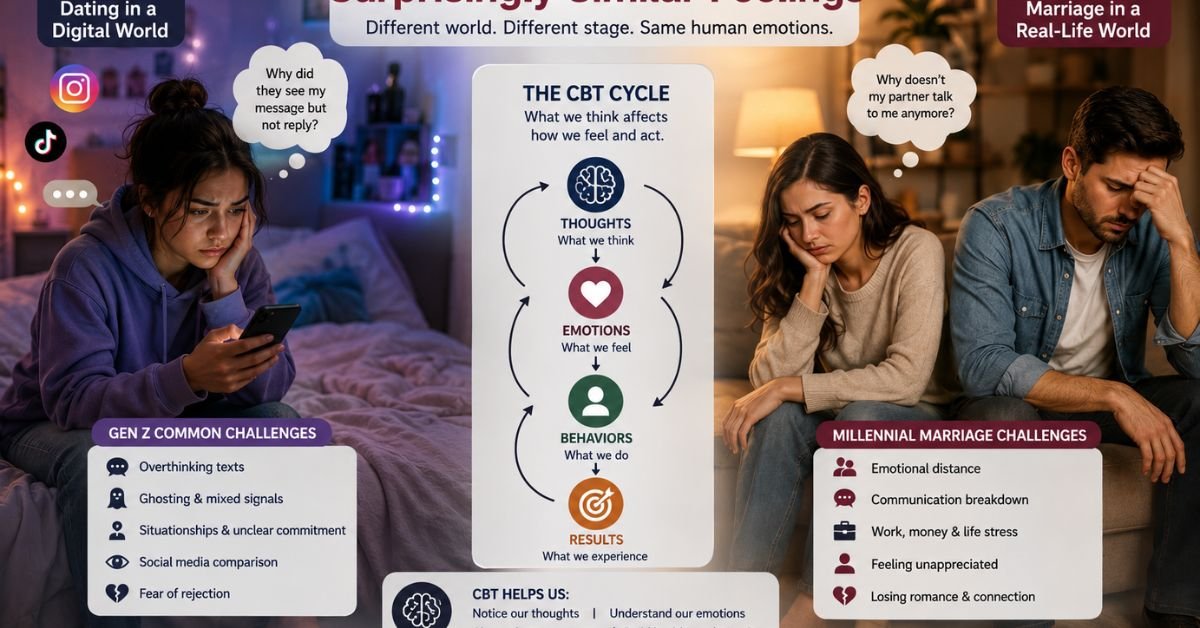
Gen Z and Millennials are often described as completely different generations.Gen Z Problems vs Millennial Marriage Problems
One grew up surrounded by smartphones, social media, dating apps, TikTok, Instagram, and instant communication.
The other experienced childhood and early adulthood before smartphones became part of almost everything.
Their relationships can look very different.Gen Z vs Millennial Marriage Problems
A Gen Z person may be wondering:
“Why did they see my message but not reply?”
A married Millennial may be wondering:
“Why does my husband/wife talk to everyone except me?”
One person is worried about being ignored online.
The other is lonely while sitting in the same house as their partner.
The situations are different.
The emotional experience can be surprisingly similar.
Both may be thinking:
That is where CBT for relationship problems becomes meaningful.Gen Z vs Millennial Marriage Problems
Cognitive Behavioral Therapy, or CBT, helps us examine the connection between situations, thoughts, emotions, and behaviors.
Instead of immediately reacting to a painful situation, CBT encourages us to pause and ask:
What happened?
What did I think it meant?
What did I feel?
How did I respond?
Did my response improve the situation or make it worse?
This article looks at the relationship challenges faced by Gen Z and Millennials through a CBT lens, while also exploring communication, social media, attachment, marriage, emotional distance, boundaries, and self-awareness.
The goal is not to decide which generation has better relationships.
The goal is to understand the patterns that can make relationships healthier.
What Are Modern Relationship Problems?Gen Z vs Millennial Marriage Problems
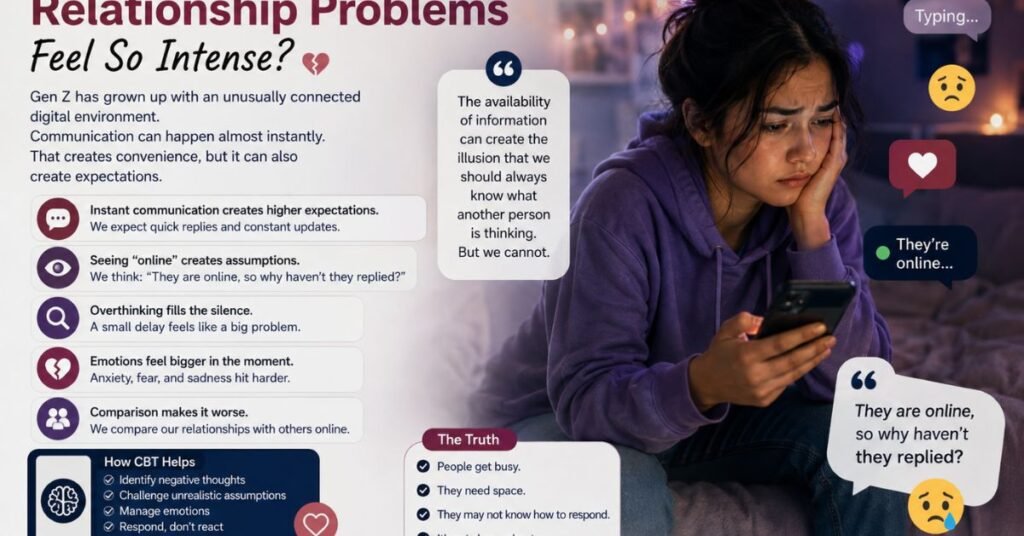
A relationship can now continue digitally even when two people are physically apart.
That can be wonderful.
It can also make emotional separation much harder.
You may stop talking to someone but still see their Stories.
You may break up but still notice their online activity.
You may be married but spend more time communicating about household responsibilities than emotions.
Modern relationships therefore need something more than romantic feelings.
They need emotional awareness.
What Is CBT for Relationship Problems?
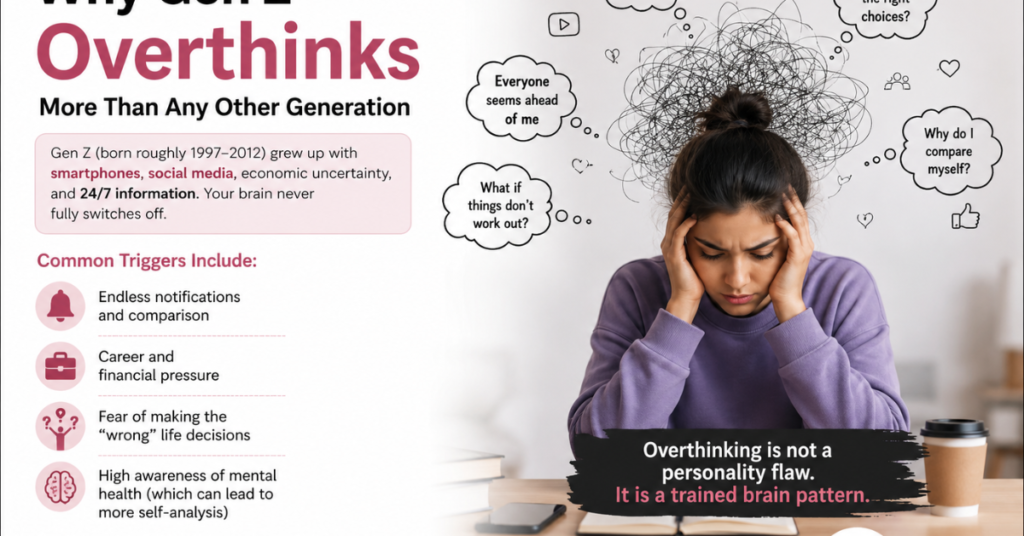
CBT stands for Cognitive Behavioral Therapy.
It is a structured psychological approach that focuses on the relationship between thoughts, emotions, and behaviors.
In relationship situations, a simple model can look like this:
Trigger → Thought → Emotion → Behavior → Consequence
For example:
Trigger
Your partner does not reply.
Thought
“They don’t care about me anymore.”
Emotion
Anxiety.
Behavior
You send several messages and repeatedly check their social media.
Consequence
The other person feels pressured.
You become more anxious.
The cycle continues.
CBT does not tell you to ignore your feelings.
It teaches you to examine the thought that appears between the event and your emotional reaction.
The goal is not:
“Don’t feel.”
The goal is:
“Understand before reacting.”
c
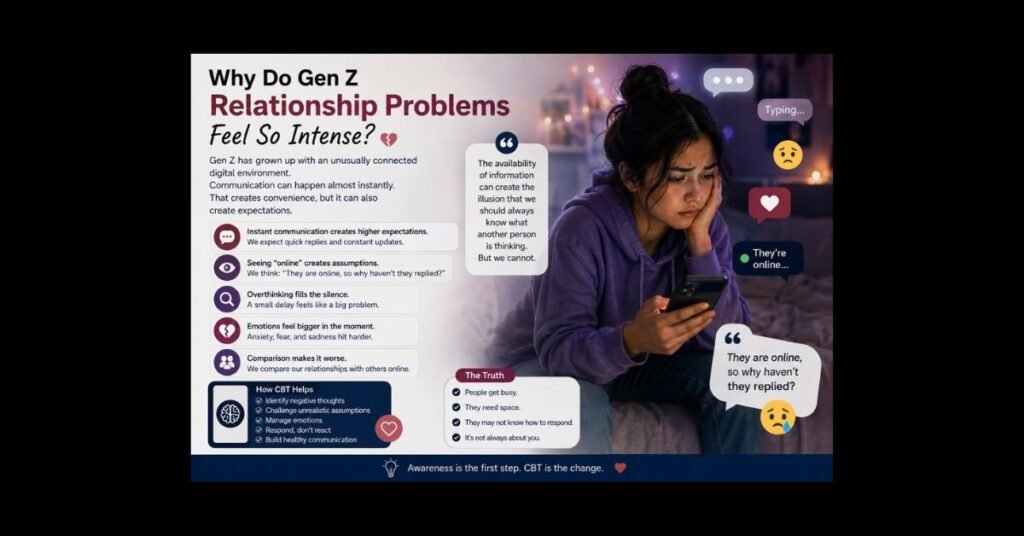
A green online status cannot tell you someone’s emotional state.
A Story cannot tell you why they are distant.
A TikTok repost cannot reliably explain their feelings.
A like does not automatically represent romantic interest.
Digital information can be real while the interpretation is wrong.
This is one reason CBT for relationship problems is useful.
It teaches people to distinguish between:
What I know
and
What I am assuming.
Gen Z Relationship Problems: The Most Common Patterns
1. Overthinking Text Messages
One of the most recognizable modern dating problems is overanalyzing communication.
A person sends:
“Hey.”
The other person replies:
“Hey.”
Then the mind starts interpreting the difference.
Why did they not use emoji?
Why did they reply with one word?
Why did they take three hours?
Why were they online?
This can create a cycle of anxiety.
CBT Reframe
Instead of:
“Their short reply means they are losing interest.”
Try:
“Their reply was short. I don’t yet know why.”
That thought is more balanced.
It leaves room for reality.
2. Ghosting and Unfinished Stories
Ghosting can be painful because it removes an opportunity for direct closure.
The brain dislikes uncertainty.
So it tries to create an explanation.
You may replay conversations.
You may examine old messages.
You may check social media.
You may wonder what you did wrong.
But sometimes the answer is simply:
You do not know.
That can be difficult to accept.
Healthy healing does not always come from getting every answer.
Sometimes it comes from accepting that you may never receive one.
3. Situationships
Situationships have become a familiar part of modern dating culture.
Two people may behave like a couple without clearly defining the relationship.
They may communicate constantly.
They may become emotionally intimate.
They may become physically close.
But they may avoid discussing commitment.
This creates a problem when expectations are different.
One person thinks:
“We are building toward a relationship.”
The other thinks:
“We’re just enjoying the connection.”
Neither person necessarily has bad intentions.
But unclear expectations can create real emotional pain.
Healthy question
Instead of asking:
“What does this behavior mean?”
Ask:
“What are we actually agreeing to?”
Clarity is healthier than endless interpretation.
4. Social Media Comparison
Social media can make relationships look perfect.
A couple posts a beautiful vacation.
Another posts flowers.
Another celebrates an anniversary.
Another shares a romantic video.
You see the result.
You do not see the entire relationship.
Comparison can create thoughts such as:
“Their partner loves them more.”
“My relationship is boring.”
“Everyone is happier than me.”
This is a cognitive distortion because the comparison is based on incomplete information.
CBT question
“Am I comparing my entire life with someone else’s selected moments?”
If yes, step back.
Your relationship does not need to perform well on social media.
It needs to work in real life.
5. Fear of Rejection
Modern dating can create repeated exposure to rejection.
A match disappears.
Someone stops replying.
A date does not lead to another date.
Someone says they are not interested.
Over time, repeated rejection can become a belief:
“Nobody will ever choose me.”
That belief can influence future relationships.
You may become overly cautious.
You may seek constant reassurance.
Or you may avoid intimacy completely.
CBT helps challenge the generalization.
One person’s rejection is information about one interaction.
It is not a permanent prediction about your entire future.
What Are Millennial Marriage Problems?
Millennials often face a different stage of relationship life.
Many are no longer asking:
“Will someone choose me?”
They may be asking:
“How do we stay connected after years together?”
Marriage introduces responsibilities that dating does not always include.
There may be:
- Careers
- Children
- Mortgages or rent
- Household responsibilities
- Financial stress
- Extended-family expectations
- Health concerns
- Parenting decisions
- Time pressure
Love can remain present while connection becomes harder.
That distinction matters.
1. Emotional Distance in Marriage
A couple can live together and still feel emotionally disconnected.
They may talk every day.
But most conversations are practical.
“Did you buy groceries?”
“What time are you coming home?”
“Did the children finish their homework?”
“Can you pay this bill?”
The relationship functions.
But emotional intimacy slowly disappears.
One partner may eventually think:
“We live together, but I don’t feel close anymore.”
This is not necessarily a sign that love has disappeared.
It can be a sign that emotional connection needs attention.
2. Communication Problems
Many marriage arguments are not really about the surface issue.
The argument may begin with dishes.
But underneath it may be:
“I feel unsupported.”
An argument about the phone may actually mean:
“I miss your attention.”
An argument about money may actually mean:
“I don’t feel secure about our future.”
An argument about parenting may actually mean:
“I feel like I am carrying this alone.”
CBT helps identify the thought and emotion underneath the visible conflict.
That can change the conversation
3. Feeling Unappreciated
Long-term relationships can create invisible labor.
One person may manage appointments.
Another may handle finances.
One may manage children.
Another may work long hours.
When effort becomes routine, appreciation can disappear.
Then resentment develops.
A person may think:
“Nobody notices what I do.”
The partner may be thinking:
“I work hard too.”
Both may feel unseen.
The solution is not necessarily deciding who works harder.
It is learning to communicate needs and recognize each other’s contributions.
4. Work Stress Entering the Marriage
Sometimes the relationship is not the original problem.
Stress enters the relationship from somewhere else.
A difficult workplace.
Financial uncertainty.
Long working hours.
Career pressure.
Exhaustion.
Then the emotional pressure gets released at home.
A person comes home tired.
Their partner asks a normal question.
The tired person reacts sharply.
The partner becomes hurt.
An argument begins.
Later, both wonder:
“Why are we always fighting?”
This is why emotional regulation matters.
Not every relationship conflict begins with a relationship problem.
5. Parenting and Marriage
Parenting can change a couple’s relationship dramatically.
There may be less private time.
Less sleep.
Less spontaneous romance.
More responsibilities.
More decisions.
More financial pressure.
A couple may love their children deeply while simultaneously struggling to maintain their connection as partners.
This does not mean they are bad parents or bad spouses.
It means relationships need intentional maintenance.
Sometimes ten minutes of genuine conversation can be more valuable than an entire evening spent physically together but emotionally distracted.
What Do Gen Z and Millennials Have in Common?

At first glance, the generations seem very different.
But their emotional needs overlap.
Both may want:
- To feel valued
- To feel understood
- To feel respected
- To feel emotionally safe
- To receive affection
- To communicate without fear
- To know where they stand
- To maintain self-respect
A Gen Z person may worry:
“Why are they not replying?”
A married Millennial may worry:
“Why don’t they talk to me anymore?”
The emotional question underneath both can be:
“Do I still matter to you?”
This is why comparing generations alone is not enough.
We need to understand the emotional pattern.
When Should You Use CBT Thinking in a Relationship?
CBT-style self-reflection can be useful whenever your emotional reaction feels much bigger than the immediate situation.
Pause when you notice:
- Repeated overthinking
- Jealousy
- Constant reassurance seeking
- Repeated checking
- Fear of abandonment
- Anger that escalates quickly
- Catastrophic thinking
- Mind-reading
- “Always” and “never” statements
- Withdrawal after conflict
The pause does not mean tolerating disrespect.
If there is abuse, coercion, intimidation, or serious harm, the priority is safety and appropriate professional support.
CBT is not a replacement for professional assessment when a situation requires it.
The CBT Relationship Thought Record
One of the most practical ways to use CBT is to write the pattern down.
| Situation | Automatic Thought | Emotion | Behavior | Balanced Thought |
| They did not reply | “They don’t care.” | Anxiety | Repeated checking | “I don’t know why they haven’t replied.” |
| Partner came home quiet | “They are angry with me.” | Fear | Became defensive | “They may simply be tired.” |
| Partner criticized something | “They don’t appreciate me.” | Hurt | Withdrew | “I can explain what I need.” |
| Couple posts online | “Their relationship is better.” | Insecurity | Comparison | “I only see one moment of their life.” |
| Partner disagrees | “They never understand me.” | Anger | Argument | “We disagree about this issue.” |
This exercise creates psychological distance from the automatic thought.
You begin observing the thought instead of immediately obeying it.
How NLP Can Complement CBT in Relationship Work
NLP can be used as a complementary framework for noticing patterns in language and communication.
The words we use can influence how we frame a situation.
Consider:
“My partner never listens.”
That statement feels permanent.
Now try:
“I don’t feel heard in this conversation.”
The second statement describes an experience.
It creates an opportunity for discussion.
Similarly:
“You always make me angry.”
can become:
“I notice I become angry when this happens.”
The second statement places attention on the interaction and your response.
This does not mean that words magically fix relationships.
Communication still requires behavior, accountability, listening, and change.
But more precise language can reduce unnecessary blame.
CBT + NLP: A Simple Relationship Reset
Use this five-step exercise.
Step 1: Notice
What happened?
Do not exaggerate.
Describe only the event.
Step 2: Name
What emotion am I feeling?
Anger?
Fear?
Sadness?
Jealousy?
Loneliness?
Step 3: Reframe
What am I telling myself about this situation?
Is the thought a fact?
Or an interpretation?
Step 4: Communicate
Turn blame into a specific need.
Instead of:
“You don’t care about me.”
Try:
“I feel disconnected and would like some uninterrupted time together.”
Step 5: Choose
Ask:
“What behavior would move this relationship in a healthier direction?”
That is where awareness becomes action.
What Can Gen Z Learn From Millennial Marriage?
Gen Z can learn that relationships require patience.
Not every difficult moment means a relationship is unhealthy.
People have bad days.
People misunderstand each other.
Communication can improve.
Compatibility takes time to understand.
A relationship is not measured only by how exciting it feels at the beginning.
Consistency matters too.
What Can Millennials Learn From Gen Z?
Millennials can learn that emotional conversations should not always be postponed.
Talking about mental health is not weakness.
Discussing boundaries does not mean rejecting commitment.
Asking for emotional support does not mean being needy.
Taking care of your mental wellbeing can strengthen—not weaken—a relationship.
The lesson is not to copy Gen Z.
It is to remain open to healthier communication.
What Does Healthy Dating Look Like?
Healthy dating does not require constant texting.
It does not require immediate replies.
It does not require checking someone’s online activity.
It does not require guessing someone’s feelings.
Healthy dating involves:
Clarity.
Consistency.
Respect.
Boundaries.
Communication.
Emotional responsibility.
You should be able to express what you want without manipulating another person into giving it to you.
What Does Healthy Marriage Look Like?
Healthy marriage is not a relationship without conflict.
It is a relationship where conflict can be handled without destroying emotional safety.
Partners can disagree.
They can apologize.
They can repair.
They can ask for space.
They can return to the conversation.
They can recognize when stress is affecting their behavior.
They can continue learning about each other.
A healthy marriage is not perfect.
It is responsive.
The Healora CBT Relationship Exercise
Here is the exercise. I would make a signature Healora tool.
“Before I React, I Ask Myself”
| Question | My Answer |
| What actually happened? | __________________ |
| What did I immediately think it meant? | __________________ |
| What emotion am I feeling? | __________________ |
| What am I afraid will happen? | __________________ |
| What evidence supports my thought? | __________________ |
| What evidence challenges it? | __________________ |
| What do I actually need? | __________________ |
| What boundary matters here? | __________________ |
| What can I control? | __________________ |
| What is one healthier response I can choose? | __________________ |
This exercise works across generations because the underlying skill is the same:
Pause before the pattern takes over.
The “If This Changes, I Will Not Lose Myself” Exercise
Relationships change.
People change.
Feelings can change.
Circumstances change.
The healthiest goal is not to control every change.
It is to build enough emotional stability that you can respond without abandoning yourself.
Complete these sentences:
If their attention changes…
I will not immediately assume I am worthless.
If communication changes…
I will communicate instead of endlessly guessing.
If they disagree with me…
I will listen without automatically seeing disagreement as rejection.
If the relationship becomes difficult…
I will examine the pattern before making an impulsive decision.
If the relationship ends…
I will grieve without making the breakup my identity.
If they come back…
I will look for consistent behavior, not only emotional promises.
This is the heart of emotional independence.
How to Know When a Relationship Pattern Needs Attention
Ask yourself:
Do I constantly need reassurance?
Do I repeatedly check someone’s phone or social media?
Do small disagreements become major arguments?
Do I avoid difficult conversations until resentment builds?
Do I assume I know what my partner is thinking?
Do I use “always” and “never” during arguments?
Do I lose my identity inside relationships?
Do I feel emotionally alone even when I am with someone?
These questions are not diagnoses.
They are invitations to become more aware.
What CBT Does Not Mean
CBT does not mean:
“Everything is your fault.”
It does not mean:
“Just think positively.”
It does not mean:
“Ignore your partner’s behavior.”
It does not mean:
“Stay in an unhealthy relationship.”
CBT helps you examine your own thoughts and behaviors while still recognizing the reality of another person’s actions.
If someone repeatedly disrespects your boundaries, the healthy response is not to think positively about it.
The healthy response may be to set a boundary, seek support, or reconsider the relationship.
When Communication Is More Important Than Interpretation
A major modern relationship problem is trying to decode instead of asking.
You analyze the Story.
You analyze the emoji.
You analyze the silence.
You analyze the tone.
You analyze the “scene.”
But sometimes the healthiest move is simply:
“Can we talk about what is happening between us?”
Communication replaces speculation.
That does not guarantee the answer you want.
But it gives you a chance to work with reality instead of imagination.
When Self-Work Becomes More Important Than Relationship Work
Sometimes the relationship is not the only thing that needs attention.
You may need to work on:
- Self-worth
- Emotional regulation
- Attachment patterns
- Communication habits
- Anger
- Jealousy
- Fear of rejection
- People-pleasing
- Overthinking
A partner cannot permanently regulate every emotion for you.
Reassurance can help.
But emotional resilience grows when you learn to soothe, challenge, and understand your own thoughts.
That is one reason CBT for relationship problems focuses on both the relationship and the individual.
A Modern Relationship Does Not Need to Be Perfect
Gen Z does not need perfect communication.
Millennial couples do not need perfect marriages.
People need relationships where mistakes can be acknowledged and repaired.
You may say something badly.
You may misunderstand.
You may become defensive.
You may need time.
The important question is:
What happens next?
Do you double down?
Or do you repair?
Do you blame?
Or do you understand?
Do you withdraw forever?
Or do you return to the conversation?
Repair is one of the most important relationship skills.
The Bigger Picture: Different Generations, Same Human Need
Gen Z and Millennials live in different relationship environments.
Gen Z may experience dating through screens.
Millennials may experience marriage through responsibilities.
But both can experience the same human emotions.
Fear.
Love.
Loneliness.
Jealousy.
Hope.
Rejection.
Attachment.
The desire to be understood.
That is why relationship education should not become a generational competition.
The question is not:
“Which generation has worse relationships?”
The better question is:
“What can we learn from these patterns?”
The Healora Approach: Awareness Before Reaction
At Healora CBT, the message is simple.
You do not have to believe every thought.
You do not have to react to every emotion.
You do not have to decode every digital signal.
You do not have to turn every disagreement into a relationship crisis.
Pause.
Notice.
Question.
Communicate.
Choose.
That is the shift from automatic reaction to emotional awareness.
CBT gives us a structured way to examine thoughts and behaviors.
NLP can complement that work by encouraging awareness of language and communication patterns.
Together, these ideas can help people become more intentional about the relationships they build and maintain.
Internal Linking Strategy for Healora CBT
This article should become a bridge article between your Gen Z content and your relationship/CBT content.
Internal Link 1
Anchor text: How to Stop Overthinking as a Gen Z
Link to your existing article:
“How to Stop Overthinking as a Gen Z: 7 CBT Techniques | Healora”
Use it in the section about texting, social media checking, and relationship anxiety.
Internal Link 2
Anchor text: Gen Z vs Millennials in Relationships
Link to your existing article:
“Gen Z vs Millennials in Relationships: A Complete CBT Guide to Love, Silence, Attachment & Communication”
Use it when discussing generational communication, attachment, silence, and modern relationships.
Internal Link 3
Future Healora article:
CBT for a Happy Married Life
Use this as a future link when you publish your married-life CBT pillar.
Internal Link 4
Future article:
Healing After Heartbreak: How to Love Without Losing Yourself
This can connect the dating section with heartbreak recovery, self-worth, and emotional independence.
Suggested External Reference Sources
For the published version, use authoritative references rather than random relationship blogs.
Good reference categories include:
- American Psychological Association for CBT and psychological concepts
- NHS for CBT information
- Peer-reviewed psychological research for relationship and CBT evidence
- Official platform resources when discussing digital wellbeing
Keep external references limited and relevant so the article remains focused on Healora rather than becoming a collection of outbound links.
Frequently Asked Questions
1. How can CBT help with relationship problems?
CBT can help people identify unhelpful automatic thoughts, understand emotional reactions, challenge assumptions, and choose healthier behaviors during relationship difficulties.
2. What are common Gen Z relationship problems?
Common challenges include overthinking communication, ghosting, situationships, social-media comparison, dating-app pressure, and fear of rejection.
3. What are common Millennial marriage problems?
Common challenges can include emotional distance, communication difficulties, work and financial stress, parenting pressure, resentment, and lack of quality time.
4. Why do Gen Z and Millennials have similar relationship struggles?
Although their life stages and technologies differ, both generations can experience the same fundamental needs for connection, reassurance, respect, emotional safety, and understanding.
5. Can CBT improve communication between couples?
CBT-based strategies can help individuals recognize unhelpful thinking patterns and communicate emotions and needs more clearly, although serious relationship difficulties may require professional couples therapy.
6. How can I stop overthinking my relationship?
Start by separating facts from assumptions, identifying the automatic thought, regulating your emotional response, communicating directly, and focusing on what you can actually control.
Conclusion
Gen Z may be learning how to build relationships in a world of constant digital communication, while Millennials may be learning how to protect emotional connection inside busy marriages.
Their problems look different.
Their emotions are often not so different.
CBT for relationship problems teaches us to pause between the trigger and the reaction, question our assumptions, communicate our needs, and choose healthier behaviors.
The goal is not a perfect relationship.
The goal is a relationship in which two people can communicate, repair, grow, and remain emotionally connected without losing themselves.
Healora’s message is simple: different generations may face different relationship problems, but awareness, CBT, healthy communication, boundaries, and emotional responsibility can help people love better without losing themselve


Pingback: Ghosting and Unfinished Stories