



1. The Person Who Was Ghosted (The Receiver)
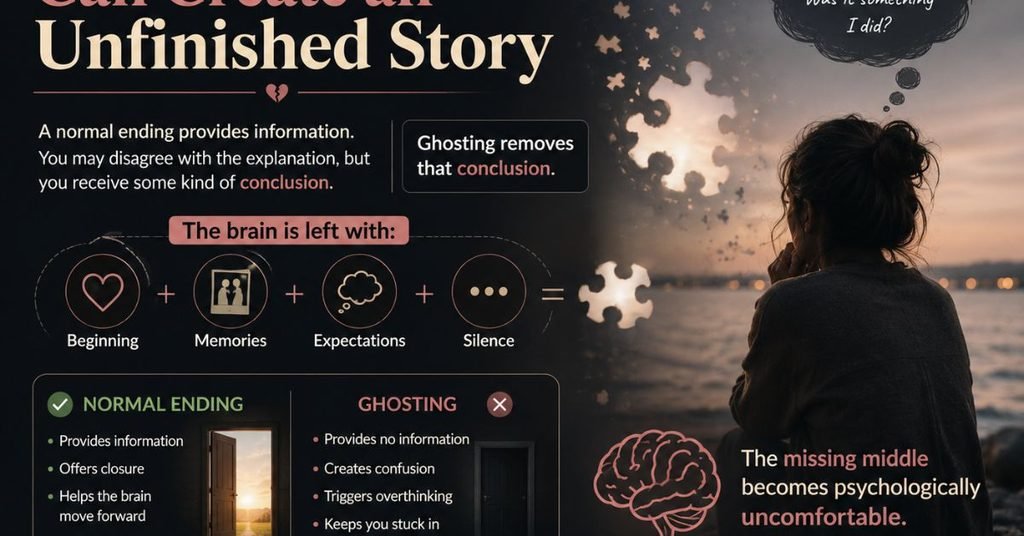
The psychological impact here is rooted in ambiguity and an interrupted reward cycle.
- The Closure Void: Without a clear ending, the brain struggles to file the experience away. It treats the relationship as an unsolved puzzle, continuously scanning memories for clues.
- Internalized Blame: Because there is no external explanation, the mind often creates one to regain a false sense of control (“If I caused it, I can fix it”). This frequently leads to intense self-doubt.
- Hyper-Vigilance: The sudden disappearance triggers a threat response, making it difficult to trust future connections or interpret ambiguous communication safely.
2. The Person Who Did the Ghosting (The Ghoster)
CBT for Ghosting by Healora
The Person Who Did the Ghosting (The Ghoster)
Ghosting is rarely just about malice; more often, it is an extreme manifestation of avoidance and emotional dysregulation.
- Avoidance Coping: Ghosters typically lack the conflict-resolution skills or emotional bandwidth to handle difficult conversations. Running away feels like the path of least resistance to protect themselves from discomfort.
- Overwhelming Anxiety: Ironically, the ghoster often experiences high anxiety regarding confrontation. The thought of expressing their truth—or seeing the other person’s pain—paralyzes them into complete silence.
- Delayed Guilt and Compartmentalization: While they may initially feel relief at escaping an awkward situation, many ghosters later experience cognitive dissonance, shame, or guilt, which they often numb by compartmentalizing or completely blocking out the situation.
The Common Thread: Fear of Vulnerability
On both sides, the cycle is driven by an underlying friction with emotional exposure. The receiver is struggling to accept a lack of closure, while the ghoster is fleeing from the vulnerability of a direct, honest goodbye.
Recognizing that ghosting is almost always a reflection of the ghoster’s capacity to handle discomfort—rather than a reflection of your worth—is often the first step in breaking the overthinking loop.
How would you like to weave this two-sided perspective into the opening framework of Part 1?
CBT Solution: Separate Facts From Stories
When you are trapped in ghosting-related overthinking, take a piece of paper and create two columns.
| Facts | Story My Mind Created |
|---|---|
| They stopped responding. | Maybe they secretly still love me. |
| Communication became inconsistent. | Maybe I wasn’t good enough. |
| I don’t have an explanation. | I need to discover the real reason. |
| The relationship ended without closure. | I cannot move on until they explain. |
This exercise is powerful because CBT teaches us to examine the difference between observable facts and interpretations.
You don’t have to fight your thoughts.You simply need to question them.
CBT Question: What Do I Actually Know?
When your brain starts creating explanations, ask:
1. What do I know for certain?
Keep it factual.
2. What am I assuming?
Identify the interpretation.
3. What evidence supports my assumption?
Look objectively.
4. What evidence doesn’t support it?
Challenge confirmation bias.
5. What would I tell a friend in the same situation?
This often creates emotional distance.
6. Do I need an answer from this person to choose peace?
This is the most important question.
Stop Confusing Missing Someone With Needing Them
You can miss someone and still know they aren’t right for you.
These two statements can exist together:
“I miss what I experienced.”
and
“I don’t want to return to the same pattern.”
Missing someone doesn’t automatically mean the relationship should continue.
Sometimes you aren’t missing the entire person.
You are missing:
- how you felt around them
- the attention
- the possibility
- the future you imagined
- the version of yourself you experienced
- the emotional intensity
- the hope that things could become different
This distinction can change your healing process.
Instead of asking:
“Why can’t I stop missing them?”
Ask:
“What exactly am I missing?”
The Person and the Memory Are Not the Same Thing
This is another important CBT reframing technique.
Your mind may replay a beautiful moment.
But a relationship is not one moment.
It is a pattern.
So instead of asking:
“Was that moment real?”
Ask:
“Was the overall relationship consistent with what I need?”
A beautiful memory can be real.
Your feelings can have been real.
The connection can have been meaningful.
And the relationship can still be unsuitable for you.
You don’t have to invalidate the good moments to accept the ending.
What If Your Body Reacts Before Your Mind?
You may suddenly experience:
- heaviness in your chest
- tension
- sadness
- restlessness
- urge to check your phone
- racing thoughts
- strong nostalgia
Don’t immediately interpret the sensation as:
“I still need them.”
Try:
“Something reminded my emotional system of an old association.”
Then pause.
Take a slow breath.
Notice the sensation.
Name the emotion.
And allow it to pass without turning it into an action.
This is an important principle of emotional regulation:
A feeling is information, not an instruction.
You can feel longing without contacting them.
You can feel sadness without checking their profile.
You can remember them without reopening the relationship.
The 90-Second Pause
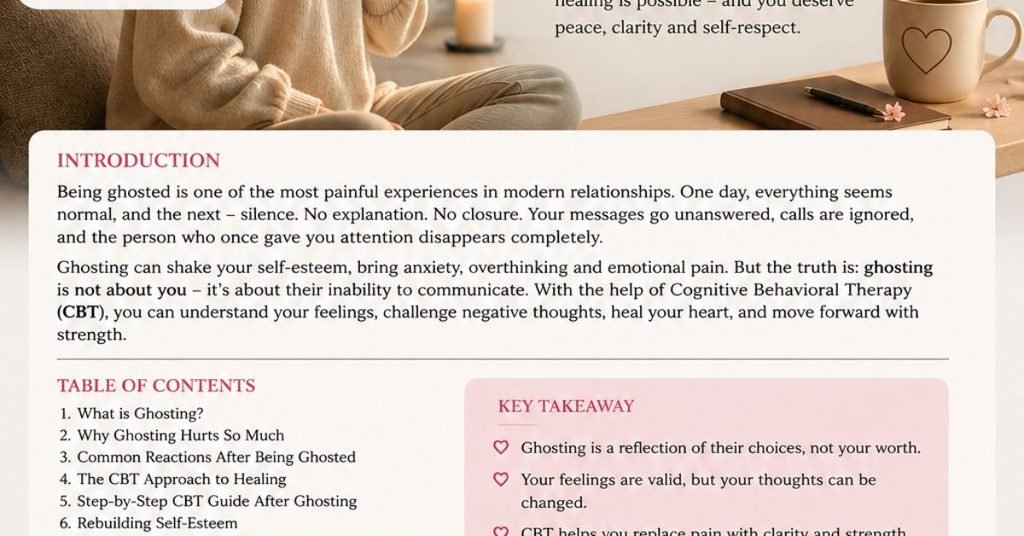
When a ghosting trigger appears, try this simple CBT-based pause:
Step 1: Notice
“I am thinking about them again.”
Step 2: Name
“This is longing.”
or
“This is uncertainty.”
or
“This is sadness.”
Step 3: Separate
“I am having the thought that I need an answer.”
Step 4: Breathe
Take several slow breaths and allow the physical sensation to settle.
Step 5: Choose
Ask:
“What action supports the person I am becoming?”
Not:
“What action will temporarily reduce my anxiety?”
This distinction matters.
Checking their profile may temporarily reduce uncertainty but strengthen the habit of checking.
Choosing not to check may feel uncomfortable initially but can weaken the cycle over time.
Don’t Feed the Memory Loop
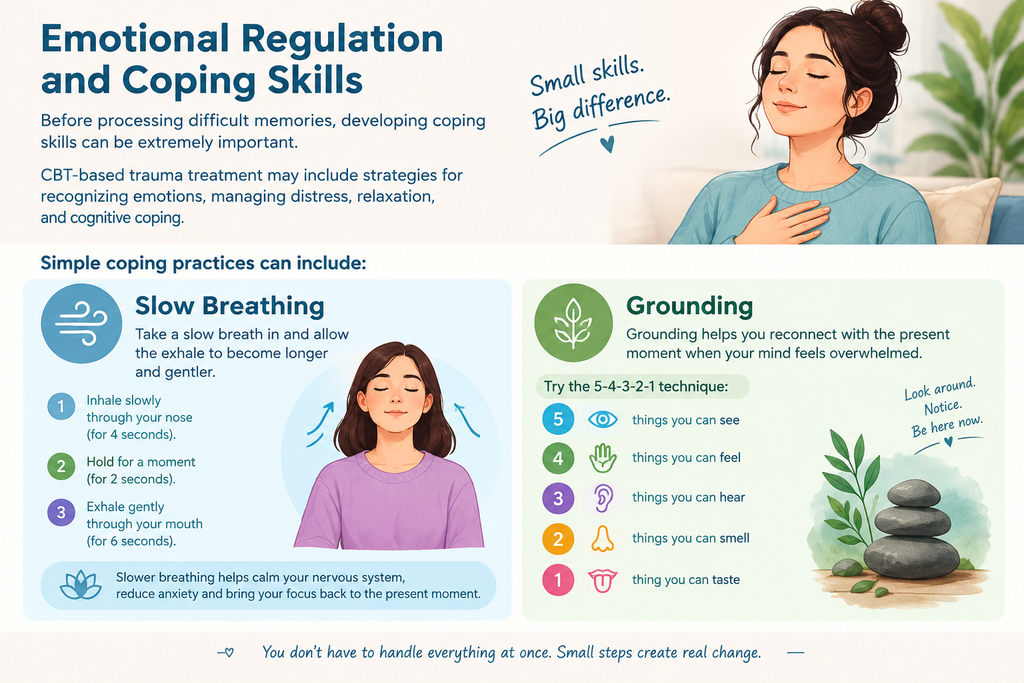
Healing doesn’t require you to erase memories.
It requires you to stop repeatedly feeding the loop.
Consider reducing behaviors such as:
- rereading old conversations
- checking their online status
- repeatedly viewing their profile
- asking mutual friends for updates
- creating imaginary conversations
- analyzing every old message
- waiting for a notification
Each behavior can become another opportunity for the brain to rehearse the same emotional pathway.
Instead, redirect your attention toward real-life experiences.
Talk to someone you trust.
Walk.
Exercise.
Journal.
Work on a personal goal.
Create new routines.
Spend time with people who communicate consistently.
Your brain needs new experiences, not just arguments against the old ones.
Create a New Ending Without Getting an Explanation
Sometimes the closure you want from another person has to become a decision you make for yourself.
Try writing:
“I may never know exactly why they disappeared.
I know how their behavior affected me.
I know what kind of communication I need.
I don’t need to solve their silence to choose my future.”
This isn’t pretending that the experience didn’t hurt.
It is refusing to make your healing dependent on another person’s explanation.
A CBT Thought Record for Ghosting
Use this whenever your mind returns to the unfinished story.
| CBT Step | Your Response |
|---|---|
| Situation | They haven’t contacted me. |
| Automatic Thought | Maybe I meant nothing to them. |
| Emotion | Sadness / anxiety / rejection |
| Intensity | 0–100 |
| Evidence For | They stopped communicating. |
| Evidence Against | I cannot know what they felt internally. |
| Balanced Thought | Their silence reflects their behavior, not my worth. |
| Healthy Action | Put my phone away and return to my life. |
The goal isn’t to replace a painful thought with fake positivity.
The goal is to create a balanced thought based on evidence.
What If They Come Back
This is where emotional healing can become complicated.
If someone returns after ghosting, don’t automatically treat their return as proof that the relationship is now healthy.
Ask:
- What changed?
- Did they acknowledge what happened?
- Are they communicating consistently?
- Are their actions matching their words?
- Do I feel emotionally safe?
- Is this a new pattern or a repetition of the old one?
A message can reopen a door.
It doesn’t automatically mean you have to walk through it.
The Real Goal of Healing
The goal isn’t:
“I will never think about this person again.”
That expectation can create another form of anxiety.
A healthier goal is:
“When I think about them, I don’t lose myself.”
You can remember without contacting.
You can feel without chasing.
You can miss without returning.
You can acknowledge the good without ignoring the painful pattern.
And eventually, the memory can become simply a memory instead of an unfinished emergency.
When Your Mind Says “Maybe,” Ask “What Is Happening Now?”
Ghosting often keeps people emotionally connected to the past because the mind keeps asking:
“What if?”
Try replacing it with:
“What is?”
What is happening now?
They are not communicating.
What do I need now?
Consistency.
What can I control now?
My attention, boundaries, choices, and healing.
What can I not control?
Another person’s decision to communicate.
This is where CBT becomes practical.
You stop trying to control the unavailable person and start working with the part of the situation that actually belongs to you.
Final CBT Reframe: Your Memory Is Not a Command
Perhaps the most important thing to remember is this:
Remembering someone doesn’t mean you belong with them.
Missing someone doesn’t mean you made the wrong decision.
Feeling your body react doesn’t mean you need to contact them.
A memory can remain while its emotional power decreases.
Your mind may still visit an old chapter.
You don’t have to live there.
Healing from ghosting isn’t about forcing yourself to forget.
It’s about teaching yourself that an unfinished story does not have to become your permanent story.
You can accept that it happened.
You can honor what you felt.
You can learn from the pattern.
And you can choose what happens next.
FAQs
Why do I keep thinking about someone who ghosted me?
Ghosting can leave uncertainty and unanswered questions. Your brain may repeatedly revisit the situation because it is trying to understand an incomplete experience. CBT can help identify and challenge the thought patterns that keep the loop active.
Why does my body react when I know the person isn’t right for me?
Emotional experiences can become associated with particular people, places, routines, and memories. A reminder can trigger a learned emotional response even when your conscious mind has already accepted the relationship is over.
Does missing someone mean I should contact them?
No. Missing someone is an emotional experience, not an instruction. You can acknowledge the feeling without acting on it.
How do I stop overthinking after ghosting?
Start by separating facts from assumptions. Identify the trigger, automatic thought, emotion, and behavior. Then challenge the thought and choose an action that supports your long-term wellbeing rather than temporarily reducing uncertainty.
Can CBT help with ghosting?
Yes. CBT can help you identify automatic thoughts, challenge unhelpful interpretations, reduce rumination, and develop healthier behavioral responses to emotional triggers.
How long does it take to stop thinking about someone who ghosted me?
There is no universal timeline. Healing depends on the relationship, emotional attachment, circumstances, coping strategies, and how much you continue reinforcing the memory loop. Progress often means the thoughts become less intense and less controlling rather than disappearing immediately.
Conclusion
Ghosting can leave you with a strange contradiction:
Your mind knows the relationship wasn’t right, but your emotional system may still remember the moments that felt right.
That doesn’t mean you’re weak.
It doesn’t mean you should go back.
And it doesn’t mean the person was necessarily your “soulmate.”
It means emotional learning takes time.
Instead of fighting every memory, learn to respond differently to it.
“I remember it, but I don’t have to return to it.”
That is where healing begins.



Pingback: The Glitch in the System HealOra | Why the Mind Replays
Pingback: Not Every Thought Is a Command HealOra