


How to Stop Overthinking as a Gen Z: 7 CBT Techniques | HealOraCBT
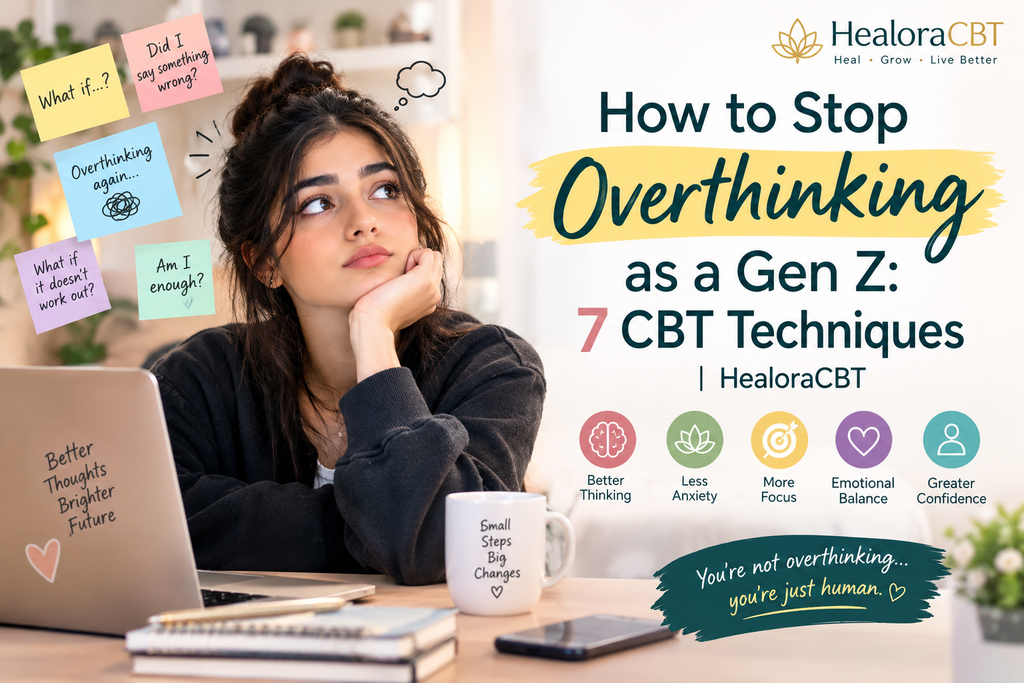
How to Stop Overthinking as a Gen Z can feel difficult when social media, relationships, studies, work, and constant notifications keep your mind active. CBT can help you identify unhelpful thought patterns, question negative assumptions, and respond to overthinking with greater awareness and calm.
How to Stop Overthinking as a Gen Z: 7 CBT Techniques | HealOraCBT
Cognitive Behavioral Therapy shows a clear chai
Trigger → Automatic Thought → Emotion → Body Sensation → More Thinking
Real-life example:Overthinking as a Gen Z: 7 CBT Techniques
- Trigger: Someone doesn’t reply to your message
- Thought: “They’re annoyed with me / I said something wrong”
- Emotion: Anxiety + self-doubt
- Body: Tight chest, restless mind
- Result: Constant checking and more overthinking
This loop feels productive, but it drains energy and rarely solves the problem.
5 Common Thinking Traps That Fuel Gen Z Overthinking
| Thinking Trap | What It Sounds Like | Healthier Alternative |
|---|---|---|
| Catastrophising | “This will ruin everything” | “This is uncomfortable, not catastrophic” |
| Mind-reading | “They think I’m weird” | “I can’t know what others are thinking” |
| All-or-nothing | “If it’s not perfect, I failed” | “Most things exist on a spectrum” |
| Should statements | “I should already have my life figured out” | “Growth takes time” |
| Over-generalisation | “I always mess things up” | “One moment doesn’t define me” |
Recognising the trap is the first step to breaking it.
How Survival Mode + Digital Overload Keep Your Mind Racing
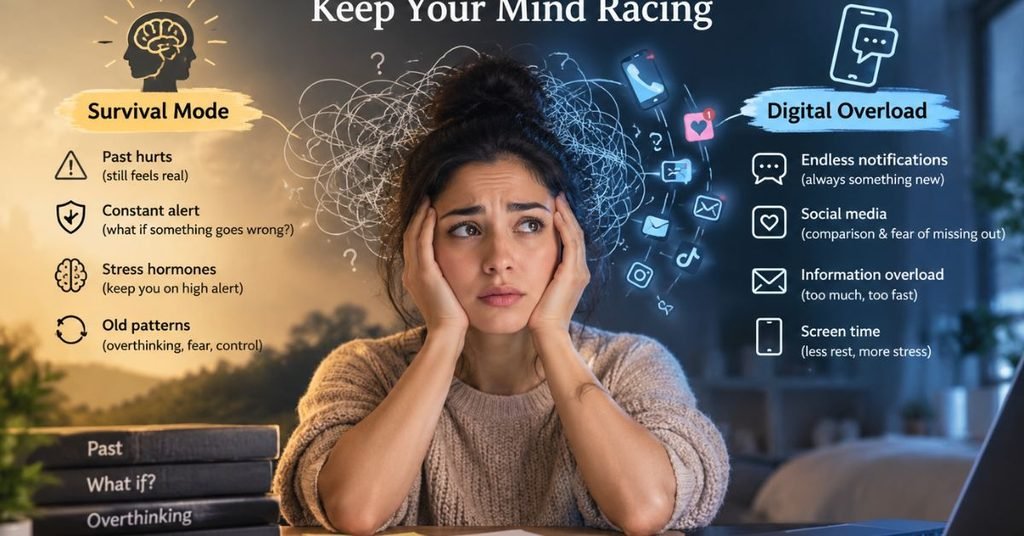
Your nervous system was built for occasional danger, not constant stimulation. Social media, news, and comparison keep stress hormones elevated.
Result: Your brain stays partially in survival mode even when you are safe. This creates shallow sleep, morning fatigue, and a mind that refuses to quiet down.
7 Practical CBT Techniques to Stop Overthinking
- Label the thought Say: “This is overthinking. This is a thought, not a fact.”
- Evidence check Ask: What evidence supports this? What evidence is against it? What would I tell a friend?
- Worry period Schedule 15–20 minutes later in the day to write worries. Outside that time, postpone them.
- Change “What if” to “If… then” Instead of “What if I fail?”, say “If I struggle, then I will ask for help.”
- Behavioural activation Do one small physical action (walk, stretch, drink water). Action often stops the mental loop faster than more thinking.
- Thought defusion Imagine the thought floating by like a cloud or a leaf on a stream.
- Name three things you can control right now This shifts the brain from threat mode to problem-solving mode.
5-Minute Daily Reset for Racing Thoughts
- Sit or stand still
- Breathe in for 4 seconds, hold 2, out for 6 (repeat 5 times)
- Name 3 things you can see, 2 you can feel, 1 you can hear
- Say: “I am safe in this moment. My mind can rest.”
- Choose one tiny next action
Do this morning and night for best results.
What Healing from Overthinking Actually Feels Like
Healing is rarely dramatic. It looks like:
- Shorter thought loops
- Ability to return to the present faster
- Fewer late-night mental rehearsals
- Lighter mornings
- More mental space for real life
Your brain can build new pathways through neuroplasticity. Consistency creates change.
Frequently Asked Questions
Why do Gen Z overthink so much? Because of constant digital stimulation, social comparison, economic uncertainty, and high self-awareness. The brain stays in a semi-alert state.
Is overthinking the same as anxiety? They often overlap. Overthinking is a thinking style. Anxiety is the emotional and physical response. CBT helps both.
Can CBT really stop overthinking? CBT does not erase thoughts. It teaches you to relate to them differently so they lose power and frequency.
How long does it take to stop overthinking? Many people notice smaller loops within 1–2 weeks of consistent practice. Deeper change builds over 4–8 weeks.
When should I seek professional help? If overthinking affects your sleep, work, relationships, or daily functioning for more than a few weeks, structured CBT support can accelerate progress.
Final Thoughts
Overthinking is not proof that something is wrong with you. It is proof that your brain has been working overtime to protect you in a noisy world.
With CBT tools, you can train your mind to rest again — one labelled thought, one evidence check, and one short reset at a time.