

Adult Love vs Childlike Love (Day 5)
Open with an emotional question.
Example:
Have you ever felt that your spouse should automatically understand your pain, fill your loneliness, or heal wounds that began long before your marriage?
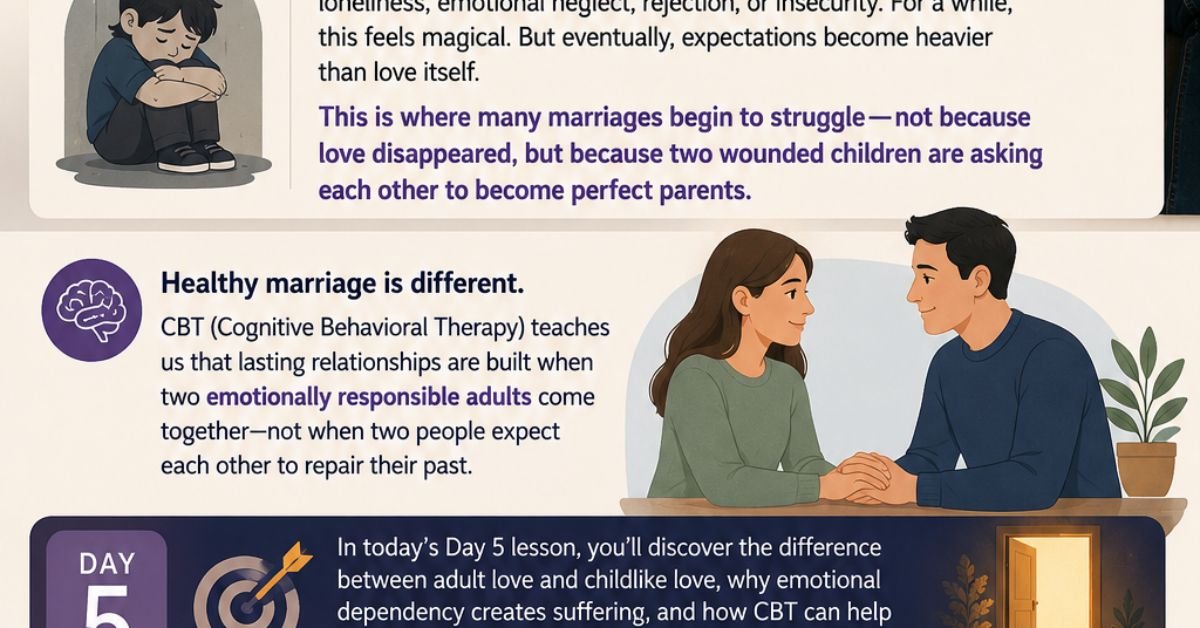
Many couples enter marriage believing love will erase childhood loneliness, emotional neglect, rejection, or insecurity. For a while, this feels magical. But eventually, expectations become heavier than love itself.
This is where many marriages begin to struggle—not because love disappeared, but because two wounded children are asking each other to become perfect parents.
Love Dynamics Reflection
Adult Love vs. Childlike Love
Use this table to reflect on how your current relationship dynamics align with these concepts.
| Feature | Childlike Love (Idealized) | Adult Love (Integrated) |
|---|---|---|
| Focus | What the partner can do for me. | What we can build together. |
| Conflict | Threatening to the connection. | An opportunity for growth. |
| Autonomy | Fear of abandonment/dependency. | Two whole individuals choosing to be together. |
Your Reflection
Which “childlike” habits do you find yourself slipping into during high-stress moments?
Healthy marriage is different.Adult Love vs Childlike Love (Day 5)
CBT (Cognitive Behavioral Therapy) teaches us that lasting relationships are built when two emotionally responsible adults come together—not when two people expect each other to repair their past.
In today’s Day 5 lesson, you’ll discover the difference between adult love and childlike love, why emotional dependency creates suffering, and how CBT can help transform your marriage into a place of growth instead of emotional survival
What Is Adult Love?Adult Love vs Childlike Love (Day 5)
Explain
Personal responsibility
Healthy boundaries
Emotional regulation
Mutual respect
Growth mindset
Love without losing identity
Include CBT explanation.
What Is Childlike Love?
Discuss
Fear of abandonment
Need for constant reassurance
People pleasing
Jealousy
Possessiveness
Emotional dependence
Seeking a parent instead of a partner
Why Childhood Experiences Shape Adult Relationships
Discuss
Attachment
Love Dynamics Reflection
Adult Love vs. Childlike Love
Use this table to reflect on how your current relationship dynamics align with these concepts.
| Feature | Childlike Love (Idealized) | Adult Love (Integrated) |
|---|---|---|
| Focus | What the partner can do for me. | What we can build together. |
| Conflict | Threatening to the connection. | An opportunity for growth. |
| Autonomy | Fear of abandonment/dependency. | Two whole individuals choosing to be together. |
Your Reflection
Which “childlike” habits do you find yourself slipping into during high-stress moments?
Family patterns
Core beliefs
Examples
“I am not enough.”
“I’ll always be abandoned
“Love must be earned.”
“I must fix everyone.”
CBT Explanation: Core Beliefs Behind Emotional Dependency
Explain
Automatic thoughts
Cognitive distortions
Examples
Mind Reading
Catastrophizing
Personalization
Emotional Reasoning
All-or-Nothing Thinking
Relationship filtering
Adult Love vs Childlike Love: A CBT Comparison Table
Example table
| Adult Love | Childlike Love |
| I choose you | I need you to survive |
| Healthy boundaries | Fear of boundaries |
| Emotional responsibility | Emotional dependence |
| Respect | Possessiveness |
| Trust | Constant reassurance |
| Growth | Fear of change |
| Partnership | Parent-child dynamic |
Signs You’re Loving as an Adult
10 signs
Signs Your Relationship Is Running on Childhood Wounds
10 warning signs
CBT Exercise 1: Identify Your Core Beliefs
Worksheet
Situation
Emotion
Thought
Evidence
Balanced belief
CBT Exercise 2: Inner Child vs Adult Self
Questions
What am I feeling?
How old does this feeling seem?
What do I need?
Can I give this to myself?
What can I request respectfully from my spouse?Adult Love vs Childlike Love (Day 5)
Love Dynamics Reflection
Adult Love vs. Childlike Love
Use this table to reflect on how your current relationship dynamics align with these concepts.
| Feature | Childlike Love (Idealized) | Adult Love (Integrated) |
|---|---|---|
| Focus | What the partner can do for me. | What we can build together. |
| Conflict | Threatening to the connection. | An opportunity for growth. |
| Autonomy | Fear of abandonment/dependency. | Two whole individuals choosing to be together. |
Your Reflection
Which “childlike” habits do you find yourself slipping into during high-stress moments?
CBT Exercise 3: Relationship Responsibility Circle
Draw three circles.Adult Love vs Childlike Love (Day 5)
My responsibility
Partner’s responsibility
Shared responsibility
Explain each.
Adult Love vs Childlike Love (Day 5)
Healthy Communication Examples
Instead of
“You never care.”
Say
“I feel lonely today. Can we spend some time together?”
Instead of
“If you loved me…”
Say
“I need reassurance.”
Story: The Marriage That Changed After They Stopped Parenting Each Other (600 words)
Create an original emotional story.Adult Love vs Childlike Love (Day 5)
Characters
Ayesha
Hamza
For years they believed they needed each other to heal everything. Adult Love vs Childlike Love (Day 5)
Adult Love vs. Childlike Love
Use this table to reflect on how your current relationship dynamics align with these concepts.
| Feature | Childlike Love (Idealized) | Adult Love (Integrated) |
|---|---|---|
| Focus | What the partner can do for me. | What we can build together. |
| Conflict | Threatening to the connection. | An opportunity for growth. |
| Autonomy | Fear of abandonment/dependency. | Two whole individuals choosing to be together. |
Your Reflection
Which “childlike” habits do you find yourself slipping into during high-stress moments?
Whenever Hamza worked late, Ayesha felt abandoned.
Whenever Ayesha became emotional, Hamza felt like a failure.
Through CBT they discovered
She wasn’t reacting to Hamza.
She was reacting to childhood loneliness.
He wasn’t avoiding her.
He was afraid of disappointing people because of his childhood.
Instead of fixing each other…
They began healing themselves.
Then they loved each other freely.
Their marriage became calmer.
Not because life became easier—
but because they finally stopped asking each other to become the parents they never had
Practical Daily Habits for Adult Love
Morning appreciationCBT for Happy Married Life: Adult Love vs Childlike Love (Day 5)Blog
Daily check-in
Healthy boundaries
Weekly date
Personal hobbies
Self-care
Gratitude
Prayer
Forgiveness
Open communication
Common CBT Mistakes Couples Make
Expecting mind readinghttps://www.attachmentproject.com/
Blaming
Avoiding conflict
Emotional suppression
Overthinking
Seeking perfection
Keeping score
FAQs
Is emotional dependency always unhealthy?
Can childhood trauma affect marriage?
How does CBT improve relationships?
Can adult love be learned?
Is attachment style permanent?
How long does CBT take to improve relationships?
Can both partners heal together?
What if only one spouse changes?
Conclusion
Adult love doesn’t ask,
“Complete me.”
It says,
“I am growing, and I choose to grow beside you.”
A healthy marriage isn’t built by two perfect people.
It’s built by two emotionally responsible people who learn to recognize old wounds without making their spouse responsible for healing every one of them.
CBT reminds us that our thoughts shape our emotions, and our emotions influence our behaviors. When we challenge unhealthy beliefs, emotional dependency slowly transforms into trust, security, and genuine intimacy.
As you continue this 21-Day Happy Married Life CBT Series, remember that lasting love grows strongest when two whole individuals choose each other every day—not because they must, but because they genuinely want to.