



Sometimes a thought does not feel like a thought. It feels like an instruction.
Your mind says, “Check again.” You feel pulled toward rereading the message. Then another thought appears: “You need to understand what happened.” Soon, you are reconstructing the conversation, looking for details, and wondering whether you missed something.
Before you realize it, you are back inside the same emotional loop.
This is where the idea of a 404 loop becomes useful. Your mind is searching for information, certainty, reassurance, or an ending that may no longer be available. Like a missing webpage, the search can continue even when there is nothing new to retrieve.
Recognizing the pattern is important, but it is only the beginning.
The more useful question is: What do you do when your mind makes a thought feel like a command?
You do not necessarily have to argue with the thought. Instead, you can notice what is happening internally and make a deliberate behavioral choice.
- When a Thought Feels More Powerful Than It Actually Is
- The Moment You Realize: “This Is a Thought, Not a Command”
- Why Understanding the Loop Is Not Always Enough
- Behavioral Action: Give Your Brain New Data
- Choose an Action That Belongs to the Present
- What If the Thought Comes Back?
- Do Not Turn Healing Into Another Rule
- Behavior Changes the Pattern
- When Your Brain Says “You Need an Answer”
- The 404 Loop Weakens When You Stop Treating Every Thought as a Task
- A Simple Response to the Mental Command
- You Do Not Need to Fix Every Error Before Moving Forward
- Final Thought: The Thought Can Stay While You Move
- References
When a Thought Feels More Powerful Than It Actually Is
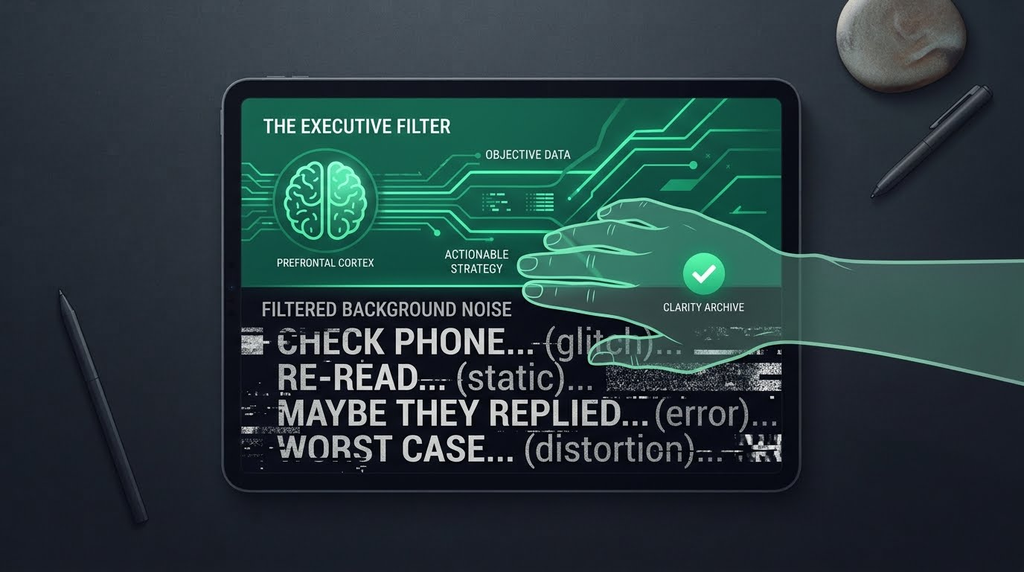
A thought can arrive with a surprising sense of urgency.
It may sound convincing. Your body may react to it. Your emotions may make it feel important enough to act on immediately.
Imagine receiving no reply to a message.
Your first thought might be:
“Check your phone.”
You check.
Nothing is there.
Then your mind offers another possibility:
“Maybe they replied somewhere else.”
You check another platform.
Still nothing.
Now you start wondering whether rereading the previous conversation might reveal something you overlooked.
You open the old messages.
For a moment, this can feel productive. You are searching, analyzing, and trying to solve something. But the search may simply create another question.
This is how an internal experience can turn into a repeated behavior.
The important distinction is that the thought itself is not necessarily the problem. What keeps the cycle going is the automatic response that follows it.
The Moment You Realize: “This Is a Thought, Not a Command”
One of the most useful CBT shifts is learning to separate what happens in your mind from what you decide to do.
Your brain produces thoughts automatically. Memories, images, questions, predictions, and emotional reactions can appear without your permission.
You might remember someone unexpectedly.
You might imagine what they would say.
You might replay part of a conversation.
You might feel drawn toward checking something.
None of these experiences automatically tells you what you have to do.
Compare these two statements:
“I need to check.”
“I noticed the urge to check.”
The first turns an internal experience into an order.
The second simply describes what is happening.
That difference creates room for choice.
You are not trying to make the thought disappear. You are learning that something can happen inside your mind without determining your next behavior.
Why Understanding the Loop Is Not Always Enough
Knowing your pattern does not automatically make it easy to change.
You may recognize that checking your phone makes you more anxious. You may understand that rereading an old conversation cannot change the ending. You may even know that another round of analysis is unlikely to produce new information.
And still, the pull can return.
Why?
Because the old behavior may have provided a brief sense of relief.
Checking can temporarily reduce uncertainty. Rereading can create the feeling that you are getting closer to an explanation. Mentally rehearsing different possibilities can give you a temporary sense of control.
That short-term relief can make the behavior easier to repeat.
This is why behavioral change matters. Instead of simply telling yourself to stop overthinking, you give yourself a different experience:
“I can feel this pull and still choose what I do next.”
Behavioral Action: Give Your Brain New Data
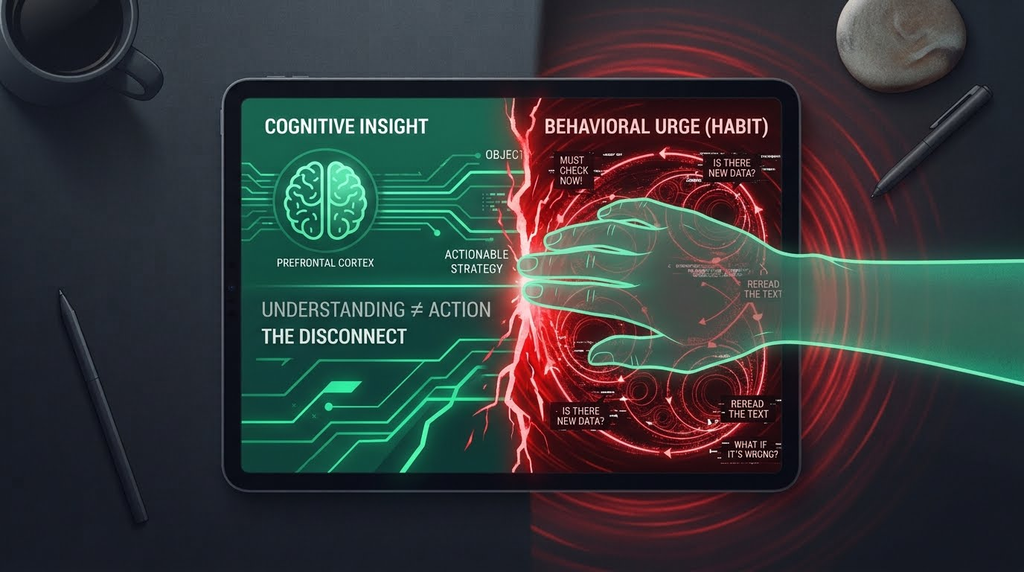
Behavioral action means responding differently while the old pattern is still tempting you.
It does not mean pretending everything is fine.
It does not mean suppressing your emotions.
It means choosing behavior instead of automatically obeying the strongest internal signal.
Suppose your mind says:
“Find out why.”
You might respond:
“I notice that I want another explanation. I am going back to what I was doing.”
Then follow through.
Finish the work in front of you. Make dinner. Take a walk. Wash the dishes. Read a few pages. Talk with a friend about something completely different.
These actions may seem ordinary, but they give you an experience your old pattern did not provide: the ability to keep living without solving the unanswered question first.
Choose an Action That Belongs to the Present
When your attention gets pulled toward an unresolved situation, choose something concrete that exists in your life right now.
A useful activity usually has a clear beginning and an achievable endpoint.
- Complete one work task.
- Take a ten-minute walk.
- Prepare something to eat.
- Organize one small area.
- Take a shower.
- Call someone you trust.
- Write the question down without investigating it.
- Return to a book, class, project, or responsibility.
This is not about distracting yourself from every difficult feeling.
It is about proving through experience that an unresolved thought does not have to pause your entire life.
What If the Thought Comes Back?
It may.
And that does not mean you are back at the beginning.
There is a difference between a thought returning and returning to the behavior that used to follow it.
You may notice the familiar pull to check again.
You can recognize it without opening the conversation.
You may notice the question coming back later.
You can acknowledge it and continue with what you are doing.
Over time, this creates a new pattern: the mental experience can appear without automatically deciding your behavior.
Do Not Turn Healing Into Another Rule
There is a subtle trap here.
After learning about overthinking, someone may create another demand:
“I must never think about this again.”
That expectation can become another source of pressure.
Your mind will continue producing memories, questions, images, predictions, and associations. That is part of normal mental activity.
The goal is not perfect control.
You can have a difficult memory without investigating it.
You can feel an emotion without immediately reacting.
You can experience uncertainty without demanding an instant answer.
You can remember someone without contacting them.
You can feel hurt without allowing that feeling to define who you are.
You can notice the mental 404 without repeatedly refreshing the same missing page.
Behavior Changes the Pattern
Each time you respond differently, you create another opportunity to learn.
At first, choosing not to check may feel uncomfortable.
That discomfort does not mean you are making the wrong choice.
With practice, you may begin to recognize the sequence sooner:
Thought → Urge → Pause → Choice → Action
The purpose is not to rewrite history or convince yourself that the situation did not matter.
It is to stop treating every reminder as something that requires an immediate response.
When Your Brain Says “You Need an Answer”
Sometimes the deepest part of the loop is the belief that you cannot move forward until you know exactly why something happened.
In some situations, an honest conversation can provide useful information.
In others, the information simply is not available.
The other person may never explain themselves. The situation may have ended without a satisfying conversation. You may never know exactly what they were thinking.
That uncertainty can hurt.
But you can ask a different question:
“How do I want to behave while I do not have this answer?”
Now your attention has moved from information you cannot control to a choice you can make.
The 404 Loop Weakens When You Stop Treating Every Thought as a Task
Your mind will sometimes leave stories unfinished.
It will revisit conversations. It will look for patterns. It will imagine alternative outcomes. It will raise questions that may never have complete answers.
You do not have to complete every mental task it generates.
A question can remain unanswered.
A memory can remain in the past.
An uncomfortable feeling can exist while you continue with your day.
An urge can rise and fall without becoming an action.
This is where behavioral flexibility becomes important.
Instead of spending all your energy trying to convince your mind to stop, you can demonstrate through your behavior that another response is possible.
For more practical CBT strategies around recurring thought patterns after ghosting, see Thinking Traps After Ghosting: 21-Day CBT Action Plan.
A Simple Response to the Mental Command
The next time an internal instruction feels unusually strong, pause before acting.
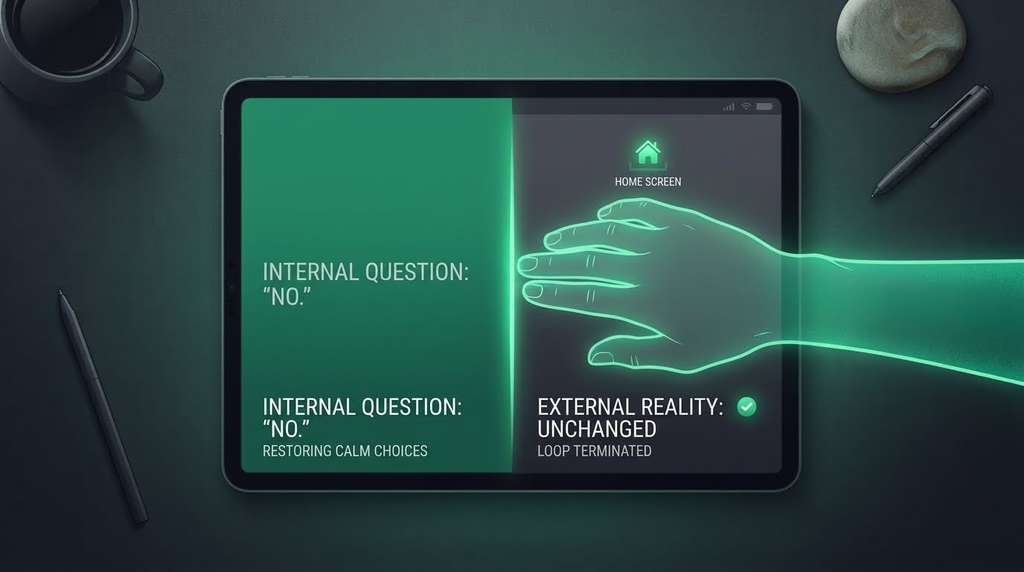
You can use this simple sequence:
- Notice: “I am having the thought that I need to check.”
- Separate: “A thought is not a command.”
- Allow: “I can feel this urge without acting on it immediately.”
- Choose: “What would support my life right now?”
- Act: Take that step, even if the thought has not disappeared.
The purpose is not to force your mind into silence.
The purpose is to change your response.
You Do Not Need to Fix Every Error Before Moving Forward
A website does not become functional because you keep refreshing a page that no longer exists.
Sometimes the useful response is to recognize that the information is unavailable and move somewhere else.
The same metaphor can help explain an emotional 404 loop.
Your mind may keep asking a situation for an explanation that it cannot provide.
You can acknowledge that desire for an answer without continuing the search indefinitely.
You might tell yourself:
“My mind is looking for an answer. I do not have to keep searching right now.”
Then take one small step toward your present life.
It may not feel dramatic.
It may simply be finishing your work, making dinner, going outside, or returning to a responsibility you temporarily put aside.
But these ordinary choices matter because they place your behavior back in your hands.
Final Thought: The Thought Can Stay While You Move
Breaking the 404 loop does not require an empty mind.
You do not have to stop remembering.
You do not have to eliminate every uncomfortable feeling.
You do not need perfect certainty before continuing with your life.
You can notice what your mind is doing and still move forward.
You can feel an urge and make a different choice.
You can live with an unanswered question while continuing to act according to your values.
Most importantly, the presence of a thought does not determine your behavior.
Your mind may send the request.
You decide whether to keep refreshing the page.
Sometimes the most meaningful response to a mental 404 is not another search for missing information.
It is behavioral action.
One present-focused choice.
Then another.
Until your life becomes bigger than the loop your mind once believed it had to solve.
References
- NHS: Cognitive behavioural therapy (CBT) — information about how CBT works with thoughts, feelings, and behaviors.
- NICE: Depression in adults — Recommendations — clinical guidance covering CBT and behavioral activation approaches.
- American Psychological Association: Depression Treatments for Adults — information about evidence-based psychological treatments including CBT.
- NHS Every Mind Matters: Thought Record — a practical CBT exercise for examining thoughts, feelings, and responses.
Educational note: This article is for educational purposes and is not a substitute for individualized mental-health care. If recurring thoughts or behaviors are causing significant distress or interfering with daily life, consider speaking with a qualified mental-health professional.
“`