

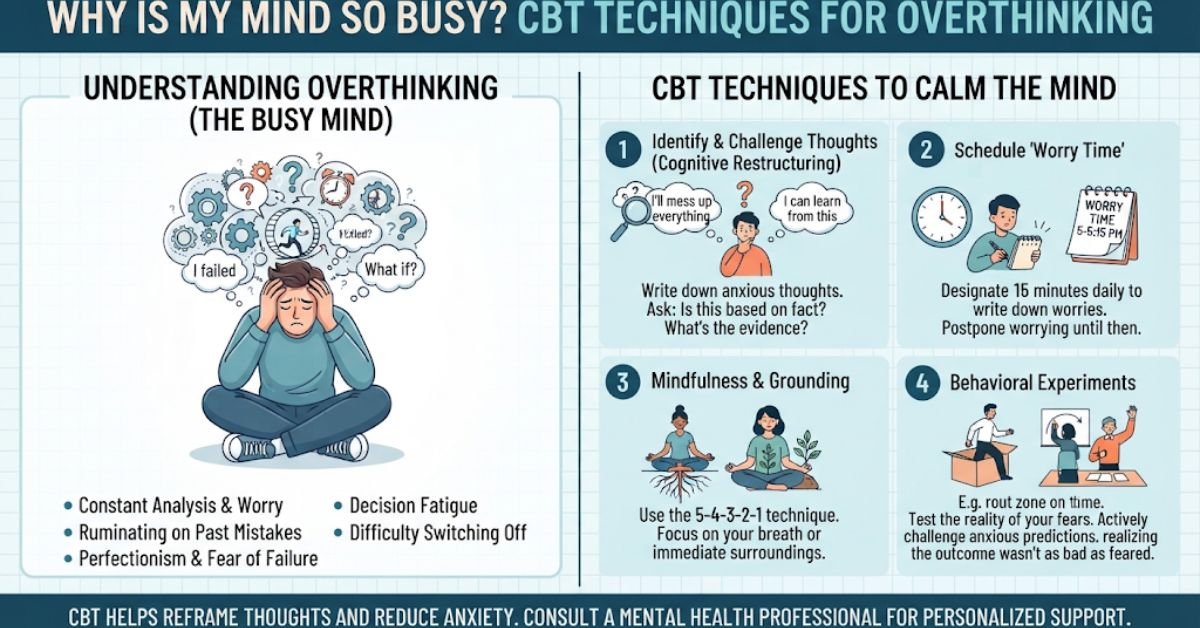
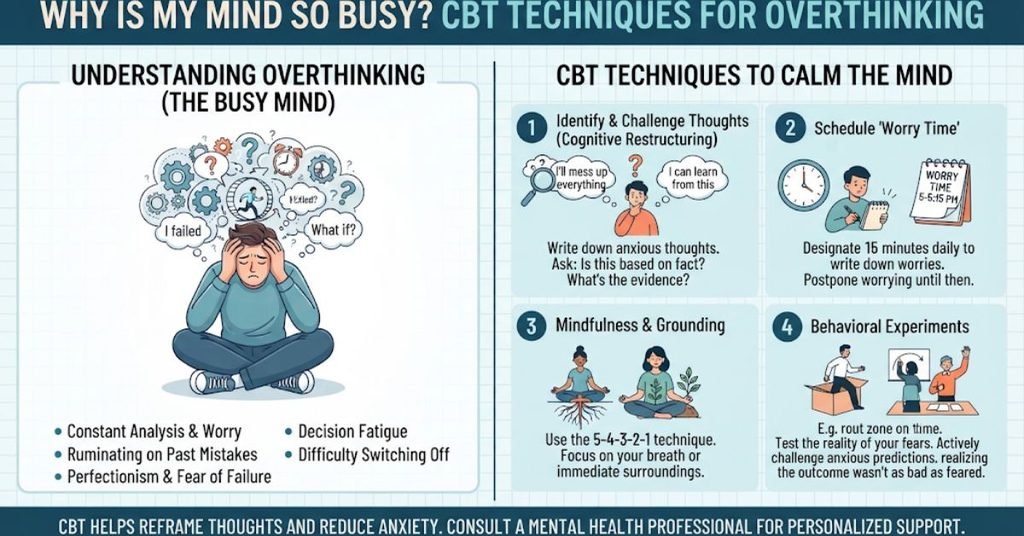
When your mind feels constantly busy, CBT techniques for overthinking can help you understand the thoughts, assumptions, and mental patterns that keep your mind active. Cognitive Behavioral Therapy (CBT) focuses on identifying unhelpful thinking patterns and developing healthier ways to respond to them.
Why Does the Mind Become So Busy? | HealOra CBT
A busy mind can happen when you are dealing with stress, uncertainty, responsibilities, difficult decisions or unresolved questions.Why Is My Mind Always Busy
Sometimes the mind tries to protect you by looking for possible problems and preparing for what might happen next.
The difficulty begins when every possibility starts to feel like a fact.
For example:Why Is My Mind So Busy? CBT Techniques
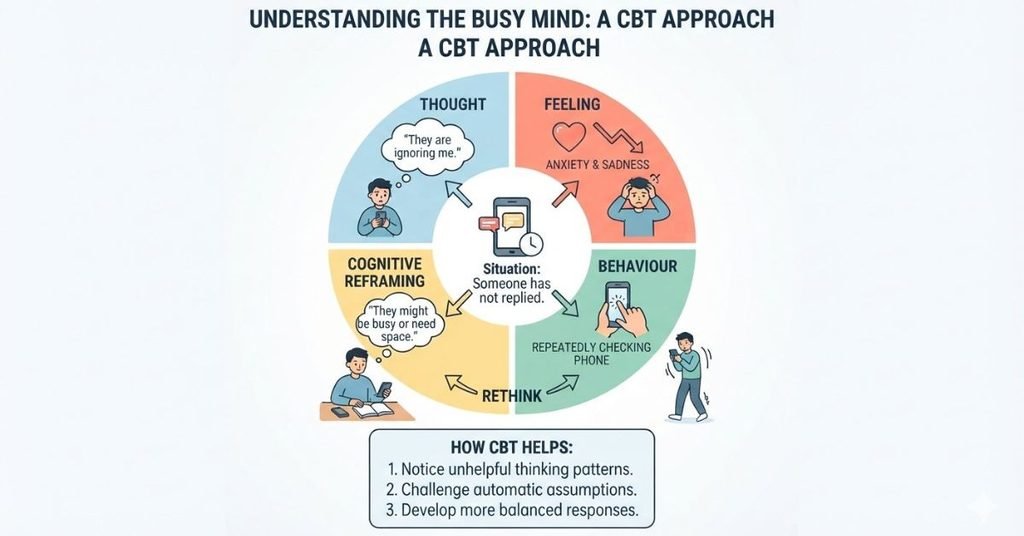
Situation: Someone has not replied.
Thought: “They are ignoring me.”
Feeling: Anxiety or sadness.
Behaviour: Checking your phone repeatedly.
CBT looks at the relationship between thoughts, feelings and behaviours. It can help you notice unhelpful thinking patterns and consider more balanced ways of responding.
Emotional Regulation
One of the most useful CBT skills is learning to create some distance from automatic thoughts.
Instead of:
“Something bad is going to happen.”Why Is My Mind So Busy? CBT Techniques
Try:
“I am having the thought that something bad might happen.”
The second statement does not deny your feelings.Why Is My Mind So Busy? CBT Techniques
It simply recognises that your mind is making a prediction.
Our minds naturally interpret situations, remember previous experiences and fill in missing information. CBT encourages you to examine those interpretations rather than automatically accepting them.
A Simple CBT Exercise for Overthinking
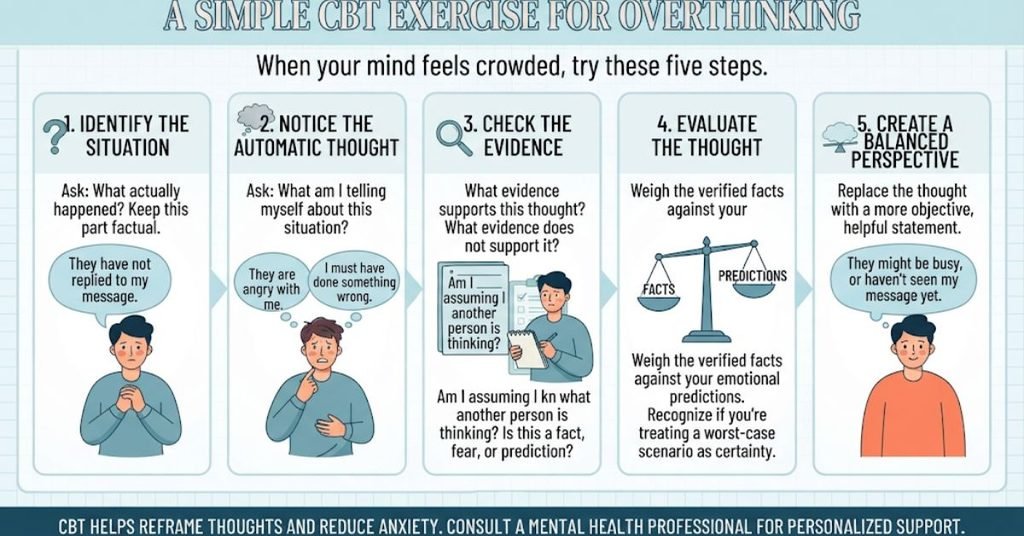
When your mind feels crowded, try these five steps.Why Is My Mind So Busy? CBT Techniques
1. Identify the Situation
Ask:
What actually happened?
Keep this part factual.
For example:
“They have not replied to my message.”
Avoid adding an explanation yet.
3. Check the Evidence
Ask:Why Is My Mind So Busy? CBT Techniques
- What evidence supports this thought?
- What evidence does not support it?
- Am I assuming I know what another person is thinking?
- Is this a fact, fear or prediction?
- Is there another reasonable explanation?
This is similar to a CBT thought record, a practical exercise used to examine situations, thoughts, feelings and alternative interpretations.
4. Create a Balanced Thought
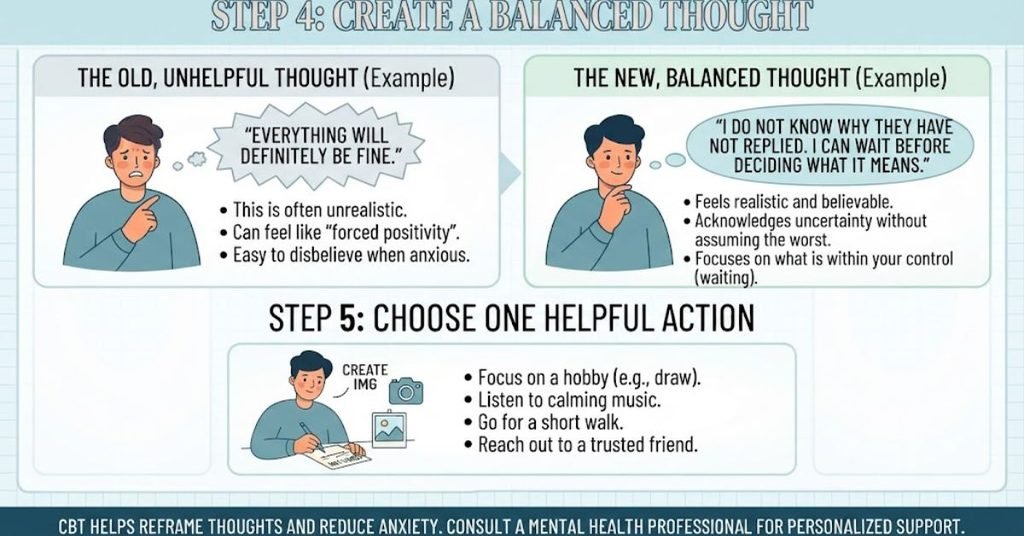
The goal is not forced positivity
Instead of:Why Is My Mind So Busy?
“Everything will definitely be fine.”
try:Why Is My Mind So Busy? Use CBT Techniques
“I do not know why they have not replied. I can wait before deciding what it means.”
A balanced thought should feel realistic enough that you can actually believe it.
5. Choose One Helpful Action
Ask:
What can I do right now?
Perhaps you can:
- put your phone down
- return to your work
- take a short walk
- postpone a decision until you are calmer
- communicate clearly
- set a reasonable boundary
- give yourself time before responding
The aim is not to solve your entire life in one moment.
It is to choose the next useful step.
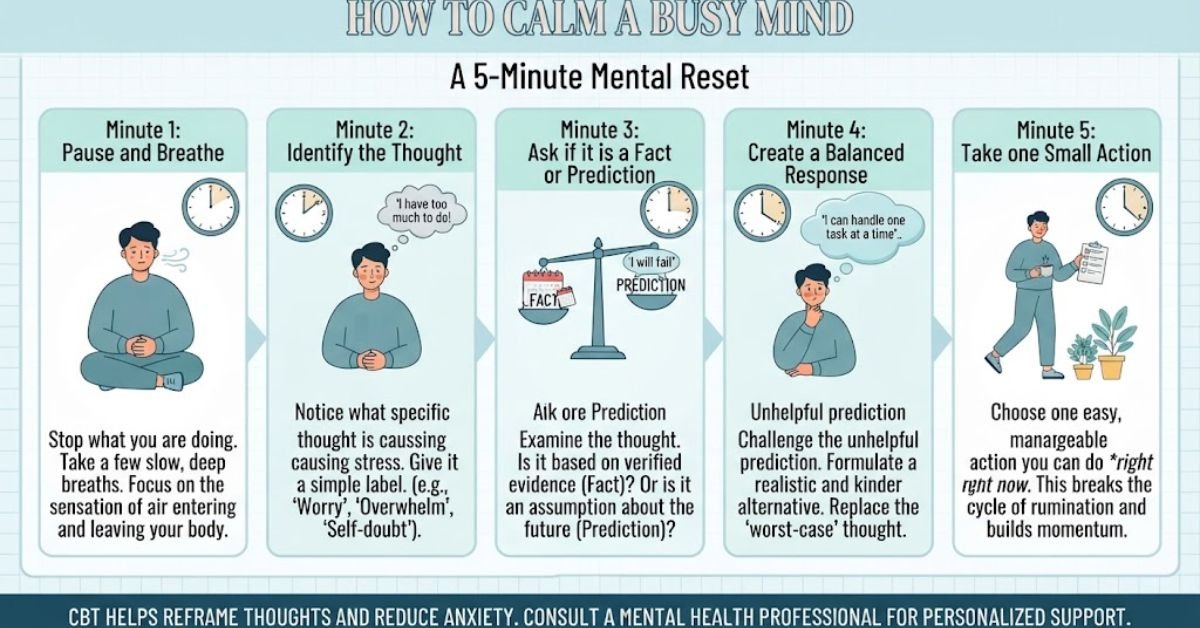
How to Calm a Busy Mind
Trying to force your mind to become completely empty can sometimes create more frustration.
Instead, try shifting your attention.
Take a few comfortable breaths and notice:
What am I thinking?
What am I feeling?
What do I need to do next?
Relaxation, mindfulness and practical CBT techniques are among the strategies recommended by NHS mental-health resources for managing anxiety and unhelpful thoughts.
You can also use a simple five-minute reset:
Minute 1: Pause and breathe comfortably.
Minute 2: Identify the thought occupying your attention.
Minute 3: Ask whether it is a fact or prediction.
Minute 4: Create a more balanced response.
Minute 5: Take one small action.
Can Visualization Help With Overthinking?
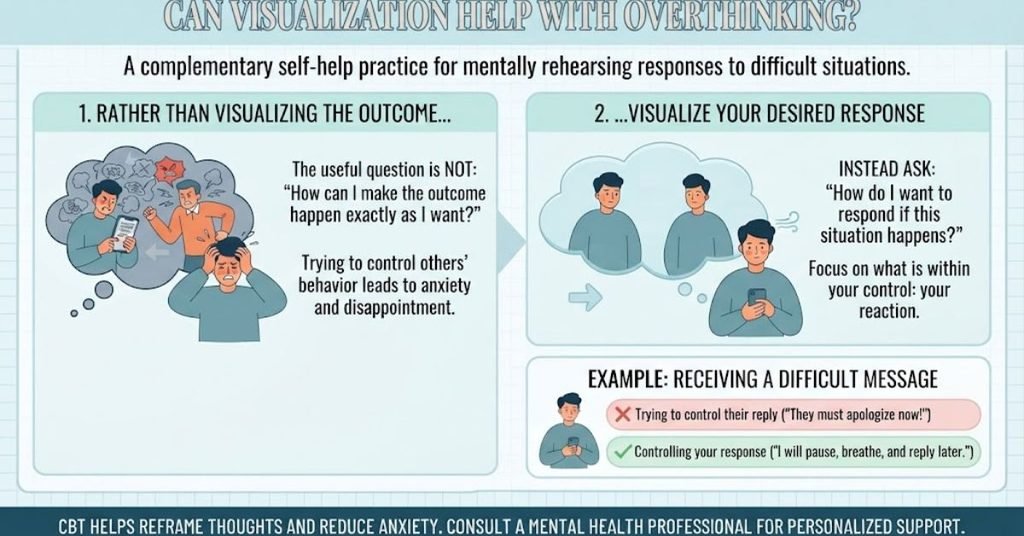
Visualization can be used as a complementary self-help practice, particularly for mentally rehearsing how you want to respond to a difficult situation.
The useful question is not:
“How can I make the outcome happen exactly as I want?”
Instead ask:
“How do I want to respond if this situation happens?”
For example, imagine receiving a difficult message.
Rather than visualising the other person behaving exactly as you hope, imagine yourself:
- pausing before replying
- breathing calmly
- asking for clarification
- speaking respectfully
- maintaining a boundary
- accepting that you cannot control another person’s reaction
This makes visualization a form of mental rehearsal rather than a promise about the future.
| . CBT | Identify Automatic Thought | “If I say no, they will think I am completely selfish.” |
| Examine & Challenge | Ask yourself: Do I actually know what they will think? (Answer: Not necessarily). | |
| Formulate Balanced Thought | “They might feel temporarily disappointed, but declining a task I cannot manage does not automatically make me a selfish person.” | |
| 2. Visualization | Mental Rehearsal | Close your eyes and picture yourself sitting calmly, maintaining steady eye contact, and delivering a clear boundary. |
| 3. Action | Real-Life Practice | Physically speak the words: “I understand this project is important, but I simply cannot take it on right now.” |
Navigating Mental Distractions
It is completely normal for your mind to drift toward past events or future to-do lists during these exercises. Distraction is not failure.
The goal of HealOraCBT is not to achieve a perfectly silent mind, but to build agility in redirecting your attention. When your focus wavers, acknowledge it neutrally and pivot bac
Scope of Self-Help Tools
Silva-style relaxation and visualization are designed as complementary self-help tools. They are intended to support general wellbeing and build personal resilience, but they are not a replacement for formal CBT protocol or clinical mental health treatment.
If mental busyness, chronic worry, or emotional distress begin to persistently disrupt your sleep, relationships, career, studies, or daily responsibilities, consider reaching out to a qualified healthcare provider for a personalized assessment
Internal links
Article mein 2–3 relevant HealOra pages link karein. For example:
- CBT / CBT techniques → your relevant CBT page
- Build Inner Resilience →
/build-inner-resilience/ - Day by Day Healing → your Day by Day page
Anchor text natural rakhein, har link mein focus keyword na ghusayein.
7. External DoFollow links
At least 2 authoritative resources:
- NHS — CBT/self-help resources
- American Psychological Association — CBT information
Frequently Asked Questions
Why is my mind so busy?
Stress, uncertainty, responsibilities and repeated worry can all contribute to a busy mind. Sometimes the mind keeps analysing a situation because it is trying to find certainty.
How can CBT help with overthinking?
CBT can help you identify automatic thoughts, examine the evidence, consider alternative interpretations and choose more helpful behaviours.
How do I stop overthinking at night?
Start by identifying the main worry rather than trying to solve every problem at once. Writing down the thought and deciding what can realistically be dealt with tomorrow may help create some mental space.
Can visualization calm an anxious mind?
Visualization may be useful as a complementary practice for relaxation or mentally rehearsing a preferred response. It should not be treated as a guarantee that a particular outcome will happen.
Is every negative thought true?
No. A thought can be an interpretation, assumption, fear or prediction. CBT encourages you to examine the evidence before treating a thought as fact.
When should I seek professional help?
Consider professional support if anxiety, persistent worry or emotional distress is interfering significantly with your daily life, relationships, sleep or ability to function.
Conclusion
You do not have to fight every thought that enters your mind.
Instead:
Notice the thought.
Check the evidence.
Create a balanced response.
Choose your next action.
A busy mind does not always need more answers.
Sometimes it needs a pause.
HealOraCBT — practical tools for understanding thoughts, emotions and everyday behaviour.
Disclaimer
This article is for educational purposes only and does not replace personalised psychological assessment, diagnosis or treatment. If you are experiencing significant or persistent emotional distress, consider speaking with a qualified mental-health professional.
Author: Khushbakht Ahmed
Certified NLP & CBT Practitioner | Emotional Healing & CBT Content Creator
HealOraCBT